Build and screen an agent
Screen a local Ollama multi-agent app, end to end
Build a LangGraph supervisor on free local models, wire it to Badge's OpenTelemetry ingest, and read back the score, the architecture graph and the per-step cost — for $0 in provider spend.
This is the whole journey in one page: a multi-agent app on your laptop, running on model weights you downloaded for free, screened by Badge over the public internet, with its internal architecture reconstructed from OpenTelemetry spans and rendered as a graph.
Everything below was executed before it was written. Where a number appears, it was measured — and where a step could not be verified, this page says so instead of guessing.
This is the long road, and it is the right one only if you want the architecture graph. If what you want is a score, Screen your first agent gets you one in about ten minutes with a single dependency-free file — no Ollama, no LangGraph, no OpenTelemetry. Come back here when you want Badge to reconstruct your agent's internals from telemetry.
Three things make this different from the three-part build journey, which you can read first but do not need to:
- The models are real. That guide's agent is deterministic Python, which is the right way to learn the screening contract but cannot exercise Badge's robustness axis. Here a real 3B model answers, so the variance, the token counts and the latency are all genuine.
- The architecture graph is the point. You will see Badge reconstruct
supervisor → researcher → writerfrom telemetry, without being told the shape in advance. - The integration mechanics are explained, not just pasted — what OTLP is, what crosses the wire, what Badge keeps, what it throws away, and why it throws it away.
What it costs and how long it takes
$0. Ollama runs the weights on your own machine, so there is no provider bill, no API key, and no trial to expire.
| Step | Time | Notes |
|---|---|---|
Install Ollama + pull llama3.2:3b | 5–10 min | ~2 GB download |
| Create the venv, install dependencies | 2 min | ~91 MB on disk |
| Run the offline test suite | ~5 s | 95 tests, no model needed |
| First real-model run | ~8 s | Includes a one-off model load |
| Badge account + agent registration | 5 min | Free tier is enough |
| A screening of 2 tasks × 3 repeats | ~1 min | 6 dispatches |
Budget about 25 minutes end to end on a first pass.
Prerequisites
Ollama. Install from ollama.com, then pull the model:
ollama serve &                  # skip if it is already running
ollama pull llama3.2:3b         # ~2 GB
Why llama3.2:3b specifically. Two hard requirements narrow the field more than you would expect:
- It must support native tool calling. Many small models do not.
llama3.2:3bandqwen2.5:3bboth work;phi:latestdoes not, and the graph below will simply never call a tool if you swap it in. - It must answer inside Badge's 60-second dispatch cap. A 3B model at Q4 quantisation is the comfortable size for consumer hardware. On an Apple M4 Pro this graph makes five model calls and completes a task in roughly 5–7 seconds; on slower hardware a 7B model can push a four-call graph past the cap.
Swap it with BADGE_OLLAMA_MODEL=qwen2.5:3b if you prefer. Anything larger is a deliberate trade of latency score for answer quality — see the latency floor below.
Everything else:
| Requirement | Version | Note |
|---|---|---|
| Python | 3.11+ | Exercised on 3.11.15 |
| RAM | 8 GB free | The 3B model resides in ~2 GB; 24 GB machine used here |
| Disk | ~2.5 GB | 2 GB model + ~91 MB venv + ~450 MB Ollama |
cloudflared | any recent | Only for the screening step |
Create the project
Everything you need is on this page. There is nothing to clone and no repository to request access to — make a directory, paste in the nine files reproduced below, and you have the complete working example. Every excerpt in the walkthrough is lifted from those same listings, and a test in Badge's CI keeps the two byte-identical, so what you read here is what Badge runs.
mkdir badge-ollama-agent && cd badge-ollama-agent
python3.11 -m venv .venv
The dependencies are split across three files on purpose, and the split is worth keeping: requirements.txt is the offline slice that needs neither a model nor a network, requirements-live.txt adds FastAPI and uvicorn for serving, and requirements-ollama.txt adds the real-model backend. Badge's CI installs only the first two — that is how it proves the offline path never quietly grows a dependency on Ollama.
Create requirements.txt:
# Exercised on Python 3.11.15 (2026-07-26). The OpenTelemetry pins match the
# versions Badge's own staging evidence run was captured on.
langchain-core==1.5.1
langgraph==1.2.9
opentelemetry-sdk==1.44.0
opentelemetry-exporter-otlp-proto-http==1.44.0
httpx==0.28.1
Create requirements-live.txt:
# Extras for the LIVE path: serving the agent over HTTP (`server.py`) so a
# real Badge deployment can screen it.
#
#     ./.venv/bin/pip install -r requirements.txt -r requirements-live.txt
#
# Add -r requirements-ollama.txt too if you want the real local model
# (BADGE_EXAMPLE_BACKEND=ollama) rather than the scripted fake backend.
#
# Deliberately separate from requirements.txt so the offline/CI slice stays
# minimal — CI installs requirements.txt only, and asserts the fake backend
# never imports langchain_ollama.
fastapi==0.140.0
uvicorn==0.51.0
Create requirements-ollama.txt:
# Extra dependency for the REAL local-model backend
# (BADGE_EXAMPLE_BACKEND=ollama). Install on top of requirements.txt:
#
#     ./.venv/bin/pip install -r requirements.txt -r requirements-ollama.txt
#
# Deliberately kept out of requirements.txt so the offline/CI path never
# needs it — CI asserts the fake backend does not import langchain_ollama.
# You also need the Ollama server itself (https://ollama.com), plus a pulled
# tool-calling model:  ollama pull llama3.2:3b
langchain-ollama==1.1.0
Then install all three:
./.venv/bin/pip install -r requirements.txt -r requirements-live.txt -r requirements-ollama.txtThe agent, and why its shape matters
The graph is a supervisor with two subagents and three tools:
badge_langchain_supervisor_demo          (LangGraph root)
├── supervisor_plan        → 1 LLM call
├── researcher             → vector_search retrieval, web_search, calculator
├── writer                 → word_count
└── supervisor_final       → 1 LLM call
Wired as a straight-line LangGraph, from agent_app.py:
graph = StateGraph(MessagesState)
graph.add_node("supervisor_plan", supervisor_plan)
graph.add_node("researcher", researcher)
graph.add_node("writer", writer)
graph.add_node("supervisor_final", supervisor_final)
graph.add_edge(START, "supervisor_plan")
graph.add_edge("supervisor_plan", "researcher")
graph.add_edge("researcher", "writer")
graph.add_edge("writer", "supervisor_final")
graph.add_edge("supervisor_final", END)
return graph.compile()
The node names are load-bearing, and this is the single most common way to lose your graph. Badge stores a subagent identity as agent:<display16>~<hash8>, where the display part must match [A-Za-z][A-Za-z0-9_-]{0,15} — at most 16 characters, starting with a letter, no dots. A name that cannot be shaped into that is dropped entirely, not truncated, and the node silently never appears.
| Node name | Stored (what you see as owner) | Public (what an anonymous reader sees) |
|---|---|---|
supervisor_plan | agent:supervisor_plan~a460b0c4 | agent:supervisor_p~1 |
researcher | agent:researcher~3588bb72 | agent:researcher~2 |
v2.supervisor | Dropped — contains a dot | — |
3rd_tier_agent | Dropped — starts with a digit | — |
research_and_synthesis_worker | Renders, truncated to research_and_syn | agent:research_and~4 |
Keep node names short, alphanumeric, letter-initial and dot-free. There is also a hard cap of 8 distinct agent identities per run, so a graph with more roles than that shows its first eight.
Note the third column, because it is a privacy decision and not a formatting one: the readable half of the node name is published to unauthenticated visitors, folded to lowercase and cut to 12 characters. The ~a460b0c4 digest is replaced by a position ordinal rather than shown. See what Badge keeps for the full two-tier projection.
Each node runs a real ChatOllama handle. The temperature assignment is not a style choice:
def make(temperature: float, tools: list[Any] | None = None) -> Any:
    model = ChatOllama(
        model=OLLAMA_MODEL,
        base_url=OLLAMA_BASE_URL,
        temperature=temperature,
        # Keep responses short: Badge caps each dispatch at 60 s, and a 3B
        # model that rambles will blow through it.
        num_predict=320,
    )
    if tools:
        model = model.bind_tools(tools)
    return model.with_config(metadata={"badge_model_id": OLLAMA_MODEL})
The complete source
Six Python files, reproduced in full. Create each one in badge-ollama-agent/, next to the .venv you just made. Nothing is elided — this is the entire example.
The first two are the ones worth reading rather than just pasting: badge_otel_callback.py is the reusable artifact, and agent_app.py is the graph the rest of the page reasons about.
badge_otel_callback.py
The LangChain-to-OpenTelemetry bridge. About 200 lines of actual logic, and the piece you are most likely to lift into your own project unchanged.
"""LangChain -> OpenTelemetry bridge for Badge's OTLP ingest.

Maps the LangChain callback run tree (run_id / parent_run_id) onto an OTel
span tree and stamps the GenAI semconv attributes Badge's ingest allowlist
accepts:

    gen_ai.request.model        gen_ai.response.model
    gen_ai.usage.input_tokens   gen_ai.usage.output_tokens
    gen_ai.usage.cost           gen_ai.tool.name
    gen_ai.agent.name           badge.response_sha256
    badge.run_id

Everything else — prompts, completions, LangChain metadata — is dropped by
Badge at ingest. This handler deliberately ALSO sets non-whitelisted
attributes (prompt text, raw answer text, framework tags) so the autodiscovery
verification can prove they never reach the DB.

Span-naming rules that matter to Badge:
  * Names are NEVER stored verbatim. They collapse to one of four labels:
    "llm" (name == "chat"/"llm"/... or prefix "chat.", "llm.", "completion.",
    "invoke_model"), "retrieval" (a small fixed set incl. "vector_search"),
    "tool" (forced whenever gen_ai.tool.name is present), else
    "unknown_operation".
  * Names with spaces (e.g. the semconv-recommended "chat gpt-4o-mini") fail
    Badge's identifier regex and collapse to "unknown_operation" — so this
    bridge uses "chat.<model>" (dot separator) for LLM spans.
  * Tool names are always stored as an opaque hash "tool:<sha256[:16]>".
  * Model IDs survive verbatim ONLY if they are in Badge's vendored LiteLLM
    price snapshot; anything else becomes an opaque "model:<sha256[:16]>".
  * Agent names (gen_ai.agent.name) are stored as a bounded projection
    "agent:<display16>~<sha256[:8]>", where the display must fullmatch
    [A-Za-z][A-Za-z0-9_-]{0,15} — 16 chars, leading letter, NO DOTS.
    Whitespace becomes "_"; URL/credential/email/hex shapes, names over 64
    chars, and names whose 16-char prefix cannot be shaped (e.g.
    "v2.supervisor", "3rd-tier-agent") are dropped entirely. At most 8
    distinct agent identities are retained per run AND per Blueprint.
    Spans that carry ONLY an agent name (LangGraph node wrappers) become
    "agent" Blueprint nodes, so the supervisor -> subagent hierarchy is
    discoverable. Keep node names short, alphanumeric, and dot-free for
    them to render.

This bridge is model-agnostic. It is exercised on two backends (see
``agent_app.py``): scripted fake chat models (deterministic, CI) and a real
local model served by Ollama (real tokens, real latency, real variance). On
the fake backend token counts and USD costs are synthesized; on the Ollama
backend both are measured, and cost is derived from energy (see
``LocalEnergyPricer``) because a locally-hosted model has no per-token price.
"""

from __future__ import annotations

import hashlib
import time
from typing import Any
from uuid import UUID

from langchain_core.callbacks import BaseCallbackHandler
from langchain_core.outputs import LLMResult
from opentelemetry import trace
from opentelemetry.trace import Span, Status, StatusCode, set_span_in_context

# Synthesized per-token USD prices, matching Badge's vendored snapshot
# (backend/app/data/model_prices_litellm.json, effective 2026-07-23) so the
# self-reported costs are plausible against Badge's own estimates.
SYNTH_PRICES: dict[str, tuple[float, float]] = {
    "claude-opus-4-6": (0.000005, 0.000025),
    "gpt-4o-mini": (0.00000015, 0.0000006),
}


class LocalEnergyPricer:
    """Derive an honest USD cost for a locally-hosted model call.

    A model running on your own hardware has no per-token price, so Badge's
    vendored price table can never cost it — every span lands in the
    ``unpriced`` bucket unless you self-report. But "free" is not the same as
    "costs nothing": the call burns electricity.

    This prices a call as ``duration x power draw x tariff``, which is a real,
    defensible number rather than a fabricated one:

        cost_usd = (seconds / 3600) x (watts / 1000) x usd_per_kwh

    Mind the /3600: watts are a rate per HOUR, and dropping the conversion
    overstates every call by 3600x (it cost this example one wrong number
    before the unit check caught it).

    The defaults describe the machine this example was exercised on (an Apple
    M4 Pro drawing roughly 40 W above idle while generating) at an EU domestic
    tariff of 0.15 USD/kWh. Both are overridable, and both are *estimates of a
    real quantity* — unlike the fake backend's invented per-token prices. The
    resulting figures are genuinely tiny (~1e-6 USD/call); that is the correct
    and interesting answer, not a rounding error to hide.
    """

    def __init__(self, watts: float = 40.0, usd_per_kwh: float = 0.15) -> None:
        self.watts = watts
        self.usd_per_kwh = usd_per_kwh

    def cost(self, seconds: float) -> float:
        kwh = (seconds / 3600.0) * (self.watts / 1000.0)
        return kwh * self.usd_per_kwh


class BadgeOtelCallbackHandler(BaseCallbackHandler):
    """Convert LangChain callback events into Badge-compatible OTel spans.

    Parameters
    ----------
    tracer:
        An OTel tracer whose provider exports OTLP/HTTP to Badge.
    badge_run_id:
        The Badge run UUID; stamped on every span (required for agent-scope
        ingest tokens; ignored — but harmless — for per-run tokens).
    report_cost_for:
        Models for which the handler sets an explicit ``gen_ai.usage.cost``
        from the ``SYNTH_PRICES`` table (Badge stores it as
        self-reported/ingested cost). Models NOT listed here but with token
        usage exercise Badge's own price-table estimate.
    energy_pricer:
        If set, any LLM span whose model is NOT in ``report_cost_for`` gets a
        measured energy-derived ``gen_ai.usage.cost`` instead. This is the
        local-model path: Badge cannot price ``llama3.2:3b``, so without this
        every span is ``unpriced``.
    probe_dropped_attrs:
        Whether to ALSO stamp deliberately non-whitelisted attributes —
        prompt text, completion text, tool input/output, the raw answer — so
        a verification run can prove Badge drops them.

        **Set this False whenever spans leave the machine.** Badge discards
        these keys at ingest, but "discarded on arrival" is not "never sent":
        with a real exporter configured they travel over the wire first, and
        on the live screening path that text is the customer's prompt. It
        defaults to True because the offline contract probes are this
        example's original purpose; ``server.py`` turns it off automatically
        the moment a real OTLP endpoint is configured.
    """

    # LangChain fires callbacks with run_id/parent_run_id UUIDs; we keep the
    # open span per run_id and parent every child explicitly via context.
    def __init__(
        self,
        tracer: trace.Tracer,
        badge_run_id: str,
        report_cost_for: set[str] | None = None,
        energy_pricer: LocalEnergyPricer | None = None,
        probe_dropped_attrs: bool = True,
    ) -> None:
        self._tracer = tracer
        self._badge_run_id = badge_run_id
        self._report_cost_for = report_cost_for or set()
        self._energy_pricer = energy_pricer
        self._probe = probe_dropped_attrs
        self._spans: dict[UUID, Span] = {}
        self._llm_started_at: dict[UUID, float] = {}
        self.final_answer_sha256: str | None = None
        # Real per-call latencies, in call order. Empty on a fake-model run
        # (those "calls" are dict lookups); the whole point of the Ollama
        # backend is that this list has a distribution worth looking at.
        self.llm_latencies_ms: list[float] = []
        # Measured usage across the whole graph — what the HTTP wrapper
        # reports back to Badge instead of guessing at 4 chars/token.
        self.total_input_tokens = 0
        self.total_output_tokens = 0
        self.tools_called: list[str] = []
        # When Badge dispatches a screening it sends a W3C `traceparent` for
        # a trace id it has ALREADY registered. Setting this makes the root
        # span join that trace instead of starting a new one — the only way
        # an agent-scope OTLP token's spans are accepted.
        self.parent_context: Any | None = None

    # ── internals ──────────────────────────────────────────────────────────

    def _start(self, name: str, run_id: UUID, parent_run_id: UUID | None) -> Span:
        parent_span = self._spans.get(parent_run_id) if parent_run_id else None
        if parent_span is not None:
            ctx = set_span_in_context(parent_span)
        else:
            # Root of the LangChain run tree: attach it to Badge's dispatch
            # trace when there is one, so the whole graph lands inside the
            # trace id Badge registered.
            ctx = self.parent_context
        span = self._tracer.start_span(name, context=ctx)
        span.set_attribute("badge.run_id", self._badge_run_id)
        self._spans[run_id] = span
        return span

    def _end(self, run_id: UUID, error: BaseException | None = None) -> None:
        span = self._spans.pop(run_id, None)
        if span is None:
            return
        if error is not None:
            # The status DESCRIPTION travels on the OTLP wire independently of
            # the attribute whitelist, and Badge never reads it — so raw
            # exception text here is the same "transmitted then discarded"
            # shape `probe_dropped_attrs` exists to prevent. LangChain and
            # provider exceptions routinely embed request content, so when
            # probes are off we send the exception TYPE only.
            detail = str(error) if self._probe else type(error).__name__
            span.set_status(Status(StatusCode.ERROR, detail))
        span.end()

    @staticmethod
    def _serialized_name(serialized: dict[str, Any] | None, **kwargs: Any) -> str:
        if kwargs.get("name"):
            return str(kwargs["name"])
        if serialized:
            if serialized.get("name"):
                return str(serialized["name"])
            if serialized.get("id"):
                return str(serialized["id"][-1])
        return "chain"

    # ── chains (LangGraph nodes, the graph itself) ─────────────────────────

    def on_chain_start(
        self,
        serialized: dict[str, Any],
        inputs: dict[str, Any],
        *,
        run_id: UUID,
        parent_run_id: UUID | None = None,
        metadata: dict[str, Any] | None = None,
        **kwargs: Any,
    ) -> None:
        name = self._serialized_name(serialized, **kwargs)
        span = self._start(name, run_id, parent_run_id)
        # WHITELISTED (G2): LangGraph stamps the graph-node name into callback
        # metadata as "langgraph_node" — that is the agent/subagent role.
        # Badge stores it as "agent:<display16>~<hash8>" and derives an "agent"
        # Blueprint node from wrapper spans, so supervisor -> subagent trees
        # survive the projection. Internal chains inside the same graph node
        # inherit the same value and collapse into one node (intended).
        langgraph_node = (metadata or {}).get("langgraph_node")
        if langgraph_node:
            span.set_attribute("gen_ai.agent.name", str(langgraph_node))
        # NOT whitelisted — must be dropped by Badge at ingest:
        if self._probe:
            span.set_attribute("langchain.framework", "langgraph")
            span.set_attribute("badge.agent_role", name)

    def on_chain_end(
        self,
        outputs: dict[str, Any],
        *,
        run_id: UUID,
        parent_run_id: UUID | None = None,
        **kwargs: Any,
    ) -> None:
        span = self._spans.get(run_id)
        if span is not None and parent_run_id is None:
            # Root span: attach the final-answer hash (whitelisted) AND the
            # raw answer text (NOT whitelisted — must be dropped by Badge).
            answer = _extract_answer(outputs)
            if answer:
                digest = hashlib.sha256(answer.encode("utf-8")).hexdigest()
                self.final_answer_sha256 = digest
                span.set_attribute("badge.response_sha256", digest)
                if self._probe:
                    span.set_attribute("badge.answer_text", answer)
        self._end(run_id)

    def on_chain_error(
        self, error: BaseException, *, run_id: UUID, **kwargs: Any
    ) -> None:
        self._end(run_id, error)

    # ── chat models ────────────────────────────────────────────────────────

    def on_chat_model_start(
        self,
        serialized: dict[str, Any],
        messages: list[list[Any]],
        *,
        run_id: UUID,
        parent_run_id: UUID | None = None,
        metadata: dict[str, Any] | None = None,
        **kwargs: Any,
    ) -> None:
        model = (metadata or {}).get("badge_model_id", "unknown-model")
        # "chat.<model>" (dot, not space): survives Badge's identifier regex
        # and its "chat." prefix rule, so the stored label is "llm".
        span = self._start(f"chat.{model}", run_id, parent_run_id)
        self._llm_started_at[run_id] = time.monotonic()
        span.set_attribute("gen_ai.request.model", model)
        # NOT whitelisted — must be dropped by Badge at ingest:
        if self._probe:
            span.set_attribute("gen_ai.prompt.0.content", _first_text(messages))

    def on_llm_end(
        self,
        response: LLMResult,
        *,
        run_id: UUID,
        parent_run_id: UUID | None = None,
        **kwargs: Any,
    ) -> None:
        started = self._llm_started_at.pop(run_id, None)
        elapsed = time.monotonic() - started if started is not None else None
        span = self._spans.get(run_id)
        if span is not None:
            message = response.generations[0][0].message  # type: ignore[attr-defined]
            usage = getattr(message, "usage_metadata", None) or {}
            model = message.response_metadata.get("model_name") or "unknown-model"
            span.set_attribute("gen_ai.response.model", model)
            input_tokens = usage.get("input_tokens")
            output_tokens = usage.get("output_tokens")
            if input_tokens is not None:
                span.set_attribute("gen_ai.usage.input_tokens", int(input_tokens))
                self.total_input_tokens += int(input_tokens)
            if output_tokens is not None:
                span.set_attribute("gen_ai.usage.output_tokens", int(output_tokens))
                self.total_output_tokens += int(output_tokens)
            if model in self._report_cost_for and model in SYNTH_PRICES:
                in_price, out_price = SYNTH_PRICES[model]
                cost = (input_tokens or 0) * in_price + (output_tokens or 0) * out_price
                span.set_attribute("gen_ai.usage.cost", round(cost, 10))
            elif self._energy_pricer is not None and elapsed is not None:
                # Local model: no per-token price exists, so price the energy.
                span.set_attribute(
                    "gen_ai.usage.cost", round(self._energy_pricer.cost(elapsed), 12)
                )
            if elapsed is not None:
                self.llm_latencies_ms.append(round(elapsed * 1000, 2))
            # NOT whitelisted — must be dropped by Badge at ingest:
            if self._probe:
                span.set_attribute("gen_ai.completion.0.content", str(message.content))
        self._end(run_id)

    def on_llm_error(
        self, error: BaseException, *, run_id: UUID, **kwargs: Any
    ) -> None:
        self._end(run_id, error)

    # ── tools ──────────────────────────────────────────────────────────────

    def on_tool_start(
        self,
        serialized: dict[str, Any],
        input_str: str,
        *,
        run_id: UUID,
        parent_run_id: UUID | None = None,
        **kwargs: Any,
    ) -> None:
        tool_name = self._serialized_name(serialized, **kwargs)
        self.tools_called.append(tool_name)
        span = self._start(f"tool.{tool_name}", run_id, parent_run_id)
        # Whitelisted, but stored as an opaque hash tool:<sha256[:16]>:
        span.set_attribute("gen_ai.tool.name", tool_name)
        # NOT whitelisted — must be dropped by Badge at ingest:
        if self._probe:
            span.set_attribute("gen_ai.tool.input", input_str)

    def on_tool_end(self, output: Any, *, run_id: UUID, **kwargs: Any) -> None:
        span = self._spans.get(run_id)
        if span is not None:
            # NOT whitelisted — must be dropped by Badge at ingest:
            if self._probe:
                span.set_attribute("gen_ai.tool.output", str(output))
        self._end(run_id)

    def on_tool_error(
        self, error: BaseException, *, run_id: UUID, **kwargs: Any
    ) -> None:
        self._end(run_id, error)

    # ── retrievers ─────────────────────────────────────────────────────────

    def on_retriever_start(
        self,
        serialized: dict[str, Any],
        query: str,
        *,
        run_id: UUID,
        parent_run_id: UUID | None = None,
        **kwargs: Any,
    ) -> None:
        # "vector_search" is in Badge's fixed retrieval-name set, so this is
        # the one non-LLM, non-tool span shape Badge classifies (label
        # "retrieval") instead of collapsing to unknown_operation.
        self._start("vector_search", run_id, parent_run_id)

    def on_retriever_end(
        self, documents: Any, *, run_id: UUID, **kwargs: Any
    ) -> None:
        self._end(run_id)

    def on_retriever_error(
        self, error: BaseException, *, run_id: UUID, **kwargs: Any
    ) -> None:
        self._end(run_id, error)


def _extract_answer(outputs: dict[str, Any]) -> str | None:
    messages = outputs.get("messages")
    if isinstance(messages, list) and messages:
        last = messages[-1]
        content = getattr(last, "content", None)
        if isinstance(content, str) and content:
            return content
    return None


def _first_text(messages: list[list[Any]]) -> str:
    for batch in messages:
        for message in batch:
            content = getattr(message, "content", None)
            if isinstance(content, str) and content:
                return content[:500]
    return ""
agent_app.py
The supervisor graph, on either a real local model or scripted fakes.
"""LangGraph supervisor + two subagents, on EITHER a real local model or fakes.

Two interchangeable backends behind one graph, selected by
``BADGE_EXAMPLE_BACKEND`` (or the ``backend=`` argument):

``fake`` (default)
    Every model is a ``GenericFakeChatModel`` with scripted ``AIMessage``
    outputs. Deterministic, offline, zero dependencies beyond langchain-core.
    This is the CI path — it must never need Ollama or a network.

``ollama``
    Every model is a real ``ChatOllama`` talking to a local Ollama server.
    Real inference, real token accounting, real latency, real variance —
    and still $0, because the weights run on your own machine.

The topology is identical on both backends, so a real-model trace is
directly comparable to the fake-model baseline:

    supervisor_plan (LLM)
      └─ researcher
           ├─ vector_search retrieval
           ├─ web_search tool
           └─ calculator tool
      └─ writer
           └─ word_count tool
      └─ supervisor_final (LLM)

Graph: START -> supervisor_plan -> researcher -> writer -> supervisor_final -> END
Each node is a LangGraph node, so the LangChain callback tree is exactly what
any LangGraph user's instrumentation would see. Node names are <=16 chars,
letter-initial and dot-free so Badge's ``gen_ai.agent.name`` projection
renders them instead of dropping them.

Two architectures behind one knob, selected by ``BADGE_EXAMPLE_ARCH`` (or the
``arch=`` argument):

``a`` (default)
    The four-role graph above — unchanged, so existing baselines stay valid.

``b``
    Inserts a ``reviewer`` role between writer and supervisor_final:

    START -> supervisor_plan -> researcher -> writer -> reviewer
          -> supervisor_final -> END

    The reviewer is deliberately a PURE LLM node — no tools, greedy — so the
    A->B blueprint diff is exactly one agent node plus rewired edges.
    Badge's observed-architecture versions are content-addressed over the
    whole span graph, and a real model's optional tool calls already mint
    behavioral variants; a tool-free role keeps the intentional change
    distinguishable from that noise.

WHY THE REAL BACKEND EXISTS: the fake backend cannot exercise Badge's
robustness axis at all (the same input always produces byte-identical output)
and its token counts and latencies are invented. A real 3B model produces
genuine run-to-run variance, genuine prompt/completion token counts, and a
genuine cold-start latency spike on the first call.
"""

from __future__ import annotations

import ast
import math
import operator
import os
import re
from typing import Any

from langchain_core.callbacks import CallbackManagerForRetrieverRun
from langchain_core.documents import Document
from langchain_core.language_models.fake_chat_models import GenericFakeChatModel
from langchain_core.messages import AIMessage, HumanMessage, SystemMessage, ToolMessage
from langchain_core.retrievers import BaseRetriever
from langchain_core.runnables import RunnableConfig
from langchain_core.tools import tool
from langgraph.graph import END, START, MessagesState, StateGraph

# ── backend selection ──────────────────────────────────────────────────────

DEFAULT_BACKEND = os.environ.get("BADGE_EXAMPLE_BACKEND", "fake").strip().lower()

# The local model. llama3.2:3b is the default because it is small enough to
# answer inside Badge's 60 s dispatch cap on consumer hardware AND supports
# native tool calling (many 3B models do not). qwen2.5:3b works identically.
OLLAMA_MODEL = os.environ.get("BADGE_OLLAMA_MODEL", "llama3.2:3b")
OLLAMA_BASE_URL = os.environ.get("OLLAMA_BASE_URL", "http://127.0.0.1:11434")

# "greedy" (default) or "sampled" — see _ollama_models() for the measured
# effect of each on Badge's robustness axis.
TEMPERATURE_PROFILE = (
    os.environ.get("BADGE_TEMPERATURE_PROFILE", "greedy").strip().lower()
)

# "a" (default) or "b" — see the module docstring. Read at build time, not
# import time, so a long-lived server restarted with a new value switches.
DEFAULT_ARCH = "a"


def resolve_arch(arch: str | None) -> str:
    resolved = (arch or os.environ.get("BADGE_EXAMPLE_ARCH", DEFAULT_ARCH)).strip().lower()
    if resolved not in {"a", "b"}:
        raise ValueError(f"unknown architecture {resolved!r}; expected 'a' or 'b'")
    return resolved

# Fake-backend model ids, chosen to exercise three different Badge price-table
# paths (known+self-reported, known+estimated, unknown+unpriced).
SUPERVISOR_MODEL = "claude-opus-4-6"  # in Badge's vendored price table
RESEARCHER_MODEL = "gpt-4o-mini"  # in Badge's vendored price table
WRITER_MODEL = "fable-fake-chat-v1"  # NOT in Badge's price table (on purpose)
REVIEWER_MODEL = "gpt-5-mini"  # arch "b" only; in Badge's vendored price table

QUESTION = (
    "How many EUR does a 3-person team spend per year on a 40 EUR/month "
    "SaaS seat, and summarize why."
)
FINAL_ANSWER = (
    "A 3-person team on a 40 EUR/month seat spends 1440 EUR per year "
    "(3 seats x 40 EUR x 12 months), before any annual-billing discount."
)


# ── tools ──────────────────────────────────────────────────────────────────


@tool
def web_search(query: str) -> str:
    """Search the reference corpus for pricing and market facts."""
    corpus = {
        "pricing": (
            "SaaS seat pricing commonly ranges 30-50 EUR/month; annual billing "
            "discounts ~10%."
        ),
        "screening": (
            "Procurement teams increasingly require independent screening before "
            "granting agents access to production systems."
        ),
        "evaluation": (
            "Benchmarks for agents measure correctness, latency, cost and "
            "robustness. Repeated runs expose nondeterminism a single run hides."
        ),
    }
    lowered = query.lower()
    for key, text in corpus.items():
        if key in lowered:
            return text
    return corpus["pricing"]


# Arithmetic is evaluated with a whitelisted AST walk. NEVER use eval() here:
# on the live-screening path this tool's argument is attacker-influenced (it
# comes from a model that is itself reading a public, unauthenticated prompt).
_BIN_OPS = {
    ast.Add: operator.add,
    ast.Sub: operator.sub,
    ast.Mult: operator.mul,
    ast.Div: operator.truediv,
    ast.Mod: operator.mod,
    ast.Pow: operator.pow,
}
_UNARY_OPS = {ast.UAdd: operator.pos, ast.USub: operator.neg}


def _eval_node(node: ast.AST) -> float:
    if isinstance(node, ast.Constant):
        if isinstance(node.value, bool) or not isinstance(node.value, (int, float)):
            raise ValueError("only numeric literals are allowed")
        return node.value
    if isinstance(node, ast.BinOp) and type(node.op) in _BIN_OPS:
        left, right = _eval_node(node.left), _eval_node(node.right)
        if isinstance(node.op, ast.Pow) and (abs(right) > 32 or abs(left) > 1e6):
            raise ValueError("exponent out of range")
        return _BIN_OPS[type(node.op)](left, right)
    if isinstance(node, ast.UnaryOp) and type(node.op) in _UNARY_OPS:
        return _UNARY_OPS[type(node.op)](_eval_node(node.operand))
    raise ValueError(f"unsupported expression element: {type(node).__name__}")


@tool
def calculator(expression: str) -> str:
    """Evaluate an arithmetic expression, e.g. "3*40*12"."""
    cleaned = expression.strip().replace("x", "*").replace("X", "*")
    if len(cleaned) > 120:
        return "error: expression too long"
    # The formatting tail MUST be inside the try. `1e400` overflows to inf,
    # `1e400-1e400` is nan, and `(-8)**0.5` returns a complex — all of which
    # raise in int()/round() rather than in the walk, and all reachable from
    # <=11 characters of attacker-influenced input.
    try:
        value = _eval_node(ast.parse(cleaned, mode="eval").body)
        if isinstance(value, complex):
            return "error: complex results are not supported"
        if not math.isfinite(value):
            return "error: result is not a finite number"
        if value == int(value):
            return str(int(value))
        return str(round(value, 6))
    except Exception as exc:  # noqa: BLE001 — tool must never raise to the graph
        return f"error: {exc}"


@tool
def word_count(text: str) -> str:
    """Count the words in a draft."""
    return str(len(text.split()))


class ReferenceRetriever(BaseRetriever):
    """Deterministic retriever so on_retriever_start/end callbacks fire.

    Named ``vector_search`` on the span, which is one of the few names Badge
    classifies as a ``retrieval`` node instead of ``unknown_operation``.
    """

    def _get_relevant_documents(
        self, query: str, *, run_manager: CallbackManagerForRetrieverRun
    ) -> list[Document]:
        return [Document(page_content="Internal note: our own seat costs 40 EUR/month.")]


TOOLS = [web_search, calculator, word_count]
TOOLS_BY_NAME = {t.name: t for t in TOOLS}
RESEARCHER_TOOLS = [web_search, calculator]
WRITER_TOOLS = [word_count]


# ── fake backend ───────────────────────────────────────────────────────────


def _ai(
    content: str,
    model: str,
    input_tokens: int,
    output_tokens: int,
    tool_calls: list[dict[str, Any]] | None = None,
) -> AIMessage:
    return AIMessage(
        content=content,
        tool_calls=tool_calls or [],
        usage_metadata={
            "input_tokens": input_tokens,
            "output_tokens": output_tokens,
            "total_tokens": input_tokens + output_tokens,
        },
        response_metadata={"model_name": model},
    )


def _fake_models() -> dict[str, Any]:
    supervisor = GenericFakeChatModel(
        messages=iter(
            [
                _ai(
                    "Plan: researcher gathers pricing facts, writer drafts the answer.",
                    SUPERVISOR_MODEL,
                    128,
                    41,
                ),
                _ai(FINAL_ANSWER, SUPERVISOR_MODEL, 402, 76),
            ]
        )
    ).with_config(metadata={"badge_model_id": SUPERVISOR_MODEL})

    researcher = GenericFakeChatModel(
        messages=iter(
            [
                _ai(
                    "",
                    RESEARCHER_MODEL,
                    212,
                    33,
                    tool_calls=[
                        {
                            "name": "web_search",
                            "args": {"query": "average SaaS seat price EUR"},
                            "id": "call_ws_1",
                            "type": "tool_call",
                        },
                        {
                            "name": "calculator",
                            "args": {"expression": "3*40*12"},
                            "id": "call_calc_1",
                            "type": "tool_call",
                        },
                    ],
                ),
                _ai(
                    "Found: 40 EUR/month per seat, 3 seats, 12 months = 1440 EUR/year.",
                    RESEARCHER_MODEL,
                    391,
                    58,
                ),
            ]
        )
    ).with_config(metadata={"badge_model_id": RESEARCHER_MODEL})

    writer = GenericFakeChatModel(
        messages=iter(
            [
                _ai(
                    "",
                    WRITER_MODEL,
                    240,
                    22,
                    tool_calls=[
                        {
                            "name": "word_count",
                            "args": {"text": "draft answer about seat pricing"},
                            "id": "call_wc_1",
                            "type": "tool_call",
                        }
                    ],
                ),
                _ai(
                    "Draft: 3 seats x 40 EUR x 12 months = 1440 EUR per year.",
                    WRITER_MODEL,
                    288,
                    47,
                ),
            ]
        )
    ).with_config(metadata={"badge_model_id": WRITER_MODEL})

    reviewer = GenericFakeChatModel(
        messages=iter(
            [
                _ai(
                    "Review: the draft is accurate (3 x 40 x 12 = 1440) and "
                    "concise. Approved without changes.",
                    REVIEWER_MODEL,
                    312,
                    28,
                )
            ]
        )
    ).with_config(metadata={"badge_model_id": REVIEWER_MODEL})

    return {
        "supervisor": supervisor,
        "researcher": researcher,
        "writer": writer,
        # Built for both architectures; arch "a" simply never invokes it. A
        # scripted iterator that is never consumed is inert.
        "reviewer": reviewer,
        # The fake backend scripts exactly two supervisor turns from one
        # iterator, so plan and final share the handle here.
        "supervisor_final": supervisor,
    }


# ── ollama backend ─────────────────────────────────────────────────────────


def _ollama_models() -> dict[str, Any]:
    """Three ChatOllama handles on the same local model, one per graph role.

    They are separate objects (not one shared handle) purely so each role can
    carry its own temperature and tool binding; they all report the same
    ``badge_model_id``, which is the honest thing to send — and which is
    exactly why every span lands in Badge's ``unpriced`` bucket.
    """
    from langchain_ollama import ChatOllama

    def make(temperature: float, tools: list[Any] | None = None) -> Any:
        model = ChatOllama(
            model=OLLAMA_MODEL,
            base_url=OLLAMA_BASE_URL,
            temperature=temperature,
            # Keep responses short: Badge caps each dispatch at 60 s, and a 3B
            # model that rambles will blow through it.
            num_predict=320,
        )
        if tools:
            model = model.bind_tools(tools)
        return model.with_config(metadata={"badge_model_id": OLLAMA_MODEL})

    # Badge's robustness axis scores agreement across repeated runs of the
    # same task, so temperature is not a style knob here — it is the score.
    # Measured on this graph, same prompt, 6 runs each:
    #
    #   sampled  (0.2/0.3/0.5/0.5) -> 6 distinct answers, 17% modal agreement
    #   sampled  (0.2/0.3/0.5/0.0) -> 5 distinct answers, 33% modal agreement
    #   greedy   (0.0/0.0/0.0/0.0) -> 1 distinct answer, 100% modal agreement
    #
    # The middle row is the useful lesson: making only the LAST hop greedy
    # barely helps, because it still receives a different draft every run.
    # Upstream variance propagates, so robustness is a property of the whole
    # graph. `greedy` is the default for exactly that reason.
    profile = TEMPERATURE_PROFILE
    if profile == "greedy":
        temperatures = {
            "supervisor": 0.0,
            "researcher": 0.0,
            "writer": 0.0,
            "reviewer": 0.0,
            "supervisor_final": 0.0,
        }
    elif profile == "sampled":
        temperatures = {
            "supervisor": 0.2,
            "researcher": 0.3,
            "writer": 0.5,
            # The reviewer stays cool even under "sampled": its job is a
            # judgment call on someone else's text, and heating it up only
            # adds variance to a role that exists to REMOVE variance.
            "reviewer": 0.1,
            "supervisor_final": 0.5,
        }
    else:
        raise ValueError(
            f"unknown temperature profile {profile!r}; expected 'greedy' or 'sampled'"
        )

    return {
        "supervisor": make(temperatures["supervisor"]),
        "researcher": make(temperatures["researcher"], RESEARCHER_TOOLS),
        "writer": make(temperatures["writer"], WRITER_TOOLS),
        "reviewer": make(temperatures["reviewer"]),
        "supervisor_final": make(temperatures["supervisor_final"]),
    }


def build_models(backend: str) -> dict[str, Any]:
    if backend == "fake":
        return _fake_models()
    if backend == "ollama":
        return _ollama_models()
    raise ValueError(f"unknown backend {backend!r}; expected 'fake' or 'ollama'")


# ── graph ──────────────────────────────────────────────────────────────────

_PLAN_SYSTEM = (
    "You are a supervisor coordinating a researcher and a writer. "
    "In at most two sentences, state the plan for answering the user's task. "
    "Do not answer the task yourself."
)
_RESEARCH_SYSTEM = (
    "You are a researcher. Gather the facts needed to answer the task. "
    "Use the calculator tool for any arithmetic and the web_search tool for "
    "pricing or market facts. State findings plainly; do not write the final "
    "answer."
)
_WRITE_SYSTEM = (
    "You are a writer. Turn the researcher's findings into a draft answer. "
    "Be concise and concrete."
)
_REVIEW_SYSTEM = (
    "You are a reviewer. Check the draft answer against the task for factual "
    "or arithmetic errors. If it is correct, restate the draft verbatim after "
    "the word APPROVED. If it has an error, output a corrected draft after "
    "the word CORRECTED. Output nothing else."
)
_FINAL_SYSTEM = (
    "You deliver the final answer. Output ONLY the answer itself.\n"
    "Rules:\n"
    "- No preamble, no sign-off, no explanation of your process.\n"
    "- No markdown code fences.\n"
    "- Never describe a function call or emit {\"name\": ..., "
    '"parameters": ...}. You have no tools; just write the answer.\n'
    "- If the task asked for JSON, emit exactly one JSON object using the "
    "field names the task asked for, in the order it asked for them.\n"
    "- If the task asked for prose, answer in at most three sentences."
)

# A 3B model ignores "no code fences" maybe one run in five. Stripping them is
# plain output normalization — the same thing every production wrapper does —
# and it is NOT answer-tampering: it removes packaging, never content.
_FENCE_RE = re.compile(r"^\s*```[a-zA-Z0-9_-]*\s*\n?(.*?)\n?\s*```\s*$", re.DOTALL)


def _normalize_answer(text: str) -> str:
    """Strip markdown fences the model was told not to emit."""
    match = _FENCE_RE.match(text)
    return match.group(1).strip() if match else text.strip()

# A real 3B model will sometimes loop on tool calls. Bound it hard: this is a
# graph that has to terminate inside a 60 s screening dispatch.
MAX_TOOL_ITERATIONS = 3


def _text(message: Any) -> str:
    content = getattr(message, "content", "")
    if isinstance(content, list):  # some providers return content blocks
        return " ".join(
            part.get("text", "") for part in content if isinstance(part, dict)
        ).strip()
    return str(content).strip()


def build_app(backend: str | None = None, arch: str | None = None) -> Any:
    backend = (backend or DEFAULT_BACKEND).strip().lower()
    arch = resolve_arch(arch)
    models = build_models(backend)
    supervisor_model = models["supervisor"]
    researcher_model = models["researcher"]
    writer_model = models["writer"]
    reviewer_model = models["reviewer"]
    final_model = models["supervisor_final"]
    retriever = ReferenceRetriever()

    def _run_tool_loop(
        model: Any, messages: list[Any], config: RunnableConfig
    ) -> list[Any]:
        """One bounded ReAct turn: model -> execute tool_calls -> model."""
        response = model.invoke(messages, config)
        messages = [*messages, response]
        iterations = 0
        while getattr(response, "tool_calls", None) and iterations < MAX_TOOL_ITERATIONS:
            iterations += 1
            for tool_call in response.tool_calls:
                name = tool_call.get("name")
                target = TOOLS_BY_NAME.get(name)
                if target is None:
                    # A real model will occasionally hallucinate a tool name.
                    # Feed the error back rather than crashing the graph.
                    result: Any = f"error: no such tool {name!r}"
                else:
                    try:
                        result = target.invoke(tool_call.get("args") or {}, config)
                    except Exception as exc:  # noqa: BLE001
                        result = f"error: {exc}"
                messages.append(
                    ToolMessage(
                        content=str(result),
                        tool_call_id=tool_call.get("id") or name or "call",
                    )
                )
            response = model.invoke(messages, config)
            messages.append(response)
        return messages

    def supervisor_plan(state: MessagesState, config: RunnableConfig) -> dict[str, Any]:
        task = _text(state["messages"][0])
        plan = supervisor_model.invoke(
            [SystemMessage(content=_PLAN_SYSTEM), HumanMessage(content=task)], config
        )
        return {"messages": [plan]}

    def researcher(state: MessagesState, config: RunnableConfig) -> dict[str, Any]:
        task = _text(state["messages"][0])
        retriever.invoke("seat cost internal notes", config)
        new_messages = _run_tool_loop(
            researcher_model,
            [
                SystemMessage(content=_RESEARCH_SYSTEM),
                HumanMessage(content="Task: " + task),
            ],
            config,
        )
        return {"messages": [new_messages[-1]]}

    def writer(state: MessagesState, config: RunnableConfig) -> dict[str, Any]:
        task = _text(state["messages"][0])
        findings = _text(state["messages"][-1])
        new_messages = _run_tool_loop(
            writer_model,
            [
                SystemMessage(content=_WRITE_SYSTEM),
                HumanMessage(
                    content=f"Task: {task}\n\nResearcher findings:\n{findings}"
                ),
            ],
            config,
        )
        return {"messages": [new_messages[-1]]}

    def reviewer(state: MessagesState, config: RunnableConfig) -> dict[str, Any]:
        task = _text(state["messages"][0])
        draft = _text(state["messages"][-1])
        review = reviewer_model.invoke(
            [
                SystemMessage(content=_REVIEW_SYSTEM),
                HumanMessage(content=f"Task: {task}\n\nDraft answer:\n{draft}"),
            ],
            config,
        )
        return {"messages": [review]}

    def supervisor_final(state: MessagesState, config: RunnableConfig) -> dict[str, Any]:
        task = _text(state["messages"][0])
        draft = _text(state["messages"][-1])
        final = final_model.invoke(
            [
                SystemMessage(content=_FINAL_SYSTEM),
                HumanMessage(content=f"Task: {task}\n\nDraft answer:\n{draft}"),
            ],
            config,
        )
        return {"messages": [final]}

    graph = StateGraph(MessagesState)
    graph.add_node("supervisor_plan", supervisor_plan)
    graph.add_node("researcher", researcher)
    graph.add_node("writer", writer)
    if arch == "b":
        graph.add_node("reviewer", reviewer)
    graph.add_node("supervisor_final", supervisor_final)
    graph.add_edge(START, "supervisor_plan")
    graph.add_edge("supervisor_plan", "researcher")
    graph.add_edge("researcher", "writer")
    if arch == "b":
        graph.add_edge("writer", "reviewer")
        graph.add_edge("reviewer", "supervisor_final")
    else:
        graph.add_edge("writer", "supervisor_final")
    graph.add_edge("supervisor_final", END)
    return graph.compile()


def run(
    callbacks: list[Any],
    prompt: str | None = None,
    backend: str | None = None,
    app: Any | None = None,
    arch: str | None = None,
) -> str:
    """Run the graph once and return the final answer text.

    ``app`` lets a long-lived server compile the graph once and reuse it; the
    fake backend's scripted message iterators are single-use, so it must
    compile a fresh app per call.
    """
    graph = app if app is not None else build_app(backend, arch)
    result = graph.invoke(
        {"messages": [HumanMessage(content=prompt or QUESTION)]},
        config={"callbacks": callbacks, "run_name": "badge_langchain_supervisor_demo"},
    )
    return _normalize_answer(_text(result["messages"][-1]))


if __name__ == "__main__":
    import sys

    cli_prompt = sys.stdin.read().strip() if not sys.stdin.isatty() else None
    print(run([], prompt=cli_prompt or None))
server.py
The HTTP wrapper that implements Badge's screening contract and the provenance handshake.
"""HTTP wrapper: serves the LangGraph agent over Badge's screening contract.

This is the piece that turns the example into something Badge can actually
screen. It implements the `badge_native` contract from
/docs/guides/build-multi-agent, and — unlike the deterministic agent in that
guide — it runs a REAL local model, so the score it earns reflects real
variance, real latency and real token counts.

It also implements the full provenance handshake, which is the part no
customer-facing doc currently spells out end to end. When Badge screens an
agent with BPP enabled, the dispatch carries:

    X-Badge-Run: true                        always
    User-Agent: Badge/<version>              always
    traceparent: 00-<trace_id>-<span_id>-01  when BPP is on
    X-Badge-Run-Id: <run uuid>               when BPP is on
    Accept-Signature: ...                    when BPP is on (RFC 9421 hint)

and Badge records `echoed: true` for the round trip only if the response
carries `X-Badge-Trace-Id: <trace_id>` back. This server therefore:

  1. extracts the W3C trace context from the incoming `traceparent`,
  2. runs the graph with every span parented INTO that registered trace,
  3. echoes `X-Badge-Trace-Id`,
  4. exports the spans to Badge's OTLP ingest with an agent-scope token.

That is the only way an agent-scope token's spans are accepted: Badge
rejects any trace id it did not itself register at dispatch (422 "OTLP trace
does not match the registered run dispatch").

Run it:

    BADGE_EXAMPLE_BACKEND=ollama PORT=8787 ./.venv/bin/python server.py

Optional, to also ship traces (agent-scope token from
POST /api/v1/agents/{id}/otlp-token):

    BADGE_OTLP_ENDPOINT=https://api-staging.badgeia.com/api/v1/provenance/otlp
    BADGE_OTLP_TOKEN=<agent-scope token>
"""

from __future__ import annotations

import asyncio
import contextlib
import json
import logging
import math
import os
import time
from typing import Any

from fastapi import FastAPI, Request, Response
from fastapi.responses import JSONResponse
from opentelemetry.sdk.resources import Resource
from opentelemetry.sdk.trace import TracerProvider
from opentelemetry.trace.propagation.tracecontext import TraceContextTextMapPropagator

from agent_app import DEFAULT_BACKEND, OLLAMA_MODEL, build_app, resolve_arch, run
from badge_otel_callback import BadgeOtelCallbackHandler, LocalEnergyPricer

BACKEND = os.environ.get("BADGE_EXAMPLE_BACKEND", DEFAULT_BACKEND).strip().lower()
# Resolved once at startup and passed explicitly, so /health reports the
# architecture this process actually serves — not whatever the env says later.
ARCH = resolve_arch(None)
OTLP_ENDPOINT = os.environ.get("BADGE_OTLP_ENDPOINT", "").strip()
OTLP_TOKEN = os.environ.get("BADGE_OTLP_TOKEN", "").strip()

# Hostile-input budgets. Badge's real screening prompts are a few KB, so
# these are generous; the point is that they are finite. Anyone with the
# tunnel URL can POST to this route.
MAX_BODY_BYTES = int(os.environ.get("BADGE_MAX_BODY_BYTES", 1 << 20))  # 1 MiB
MAX_PROMPT_CHARS = int(os.environ.get("BADGE_MAX_PROMPT_CHARS", 100_000))
# Badge gives up on a dispatch at 60 s; finishing after that wins nothing and
# keeps a worker busy.
RUN_TIMEOUT_SECONDS = float(os.environ.get("BADGE_RUN_TIMEOUT_SECONDS", 60))
MAX_CONCURRENT_RUNS = int(os.environ.get("BADGE_MAX_CONCURRENT_RUNS", 2))

@contextlib.asynccontextmanager
async def _lifespan(_: FastAPI):
    yield
    # Flush queued spans on the way out. BatchSpanProcessor holds the last
    # batch in memory, so without this the final run's trace is simply lost.
    with contextlib.suppress(Exception):
        _provider.force_flush(timeout_millis=10_000)


# Serve exactly two routes and nothing else. A tunnel publishes EVERY path on
# the port, so FastAPI's interactive docs would otherwise go public too.
app = FastAPI(docs_url=None, redoc_url=None, openapi_url=None, lifespan=_lifespan)

_propagator = TraceContextTextMapPropagator()
_pricer = LocalEnergyPricer()
_slots = asyncio.Semaphore(MAX_CONCURRENT_RUNS)

# The graph is compiled once and reused across requests on the real backend.
# The fake backend's scripted message iterators are single-use, so it must
# recompile per request instead.
_APP = build_app(BACKEND, ARCH) if BACKEND != "fake" else None

_provider = TracerProvider(
    resource=Resource.create({"service.name": "badge-langgraph-ollama-reference"})
)
_exporting = False
if OTLP_ENDPOINT and OTLP_TOKEN:
    from opentelemetry.exporter.otlp.proto.http.trace_exporter import OTLPSpanExporter
    from opentelemetry.sdk.trace.export import BatchSpanProcessor

    # Batch, not Simple: exporting inline would add network latency to a
    # response that has a 60 s budget. Badge accepts a run's spans after the
    # run itself completes, which is what makes async export safe here.
    _provider.add_span_processor(
        BatchSpanProcessor(
            OTLPSpanExporter(
                endpoint=OTLP_ENDPOINT,
                headers={"Authorization": f"Bearer {OTLP_TOKEN}"},
                timeout=20,
            )
        )
    )
    _exporting = True

_tracer = _provider.get_tracer("badge.langchain.reference")


def approx_tokens(text: str) -> int:
    """Fallback only — the real counts come from the model's usage metadata."""
    return max(1, math.ceil(len(text) / 4)) if text else 0


@app.get("/health")
async def health() -> dict[str, Any]:
    return {
        "status": "ok",
        "backend": BACKEND,
        "architecture": ARCH,
        "model": OLLAMA_MODEL if BACKEND == "ollama" else "scripted-fake",
        "otlp_export": _exporting,
        "routes": ["GET /health", "POST /execute"],
    }


@app.post("/execute")
async def execute(request: Request) -> Response:
    started = time.perf_counter()

    # This route is PUBLIC and unauthenticated by design (Badge sends no
    # credentials), so treat the body as hostile. Badge's own ingest does the
    # same thing — declared-length precheck plus a streaming cap, because
    # Content-Length is absent on a chunked upload and trivially forged.
    declared = request.headers.get("content-length")
    if declared and declared.isdigit() and int(declared) > MAX_BODY_BYTES:
        return JSONResponse({"error": "request body too large"}, status_code=413)
    chunks: list[bytes] = []
    received = 0
    async for chunk in request.stream():
        received += len(chunk)
        if received > MAX_BODY_BYTES:
            return JSONResponse({"error": "request body too large"}, status_code=413)
        chunks.append(chunk)

    try:
        body = json.loads(b"".join(chunks))
    except Exception:
        return JSONResponse({"error": "body must be valid JSON"}, status_code=400)
    if not isinstance(body, dict) or not isinstance(body.get("prompt"), str):
        return JSONResponse({"error": "'prompt' is required"}, status_code=400)
    if len(body["prompt"]) > MAX_PROMPT_CHARS:
        return JSONResponse({"error": "prompt too long"}, status_code=413)

    # body also carries task_id, max_tokens and — for non-secret tasks —
    # expected_output. We deliberately never read expected_output: grading
    # yourself against the answer key is not work, and it is absent exactly
    # when the task matters most (secret holdout suites).
    prompt = body["prompt"]

    # Adopt Badge's registered trace, if this is a real screening dispatch.
    carrier = {
        key.lower(): value
        for key, value in request.headers.items()
        if key.lower() in {"traceparent", "tracestate"}
    }
    parent_context = _propagator.extract(carrier) if carrier else None
    incoming_trace_id = None
    if parent_context is not None:
        from opentelemetry.trace import get_current_span

        span_context = get_current_span(parent_context).get_span_context()
        if span_context.is_valid:
            incoming_trace_id = format(span_context.trace_id, "032x")

    handler = BadgeOtelCallbackHandler(
        _tracer,
        badge_run_id=request.headers.get("X-Badge-Run-Id", ""),
        report_cost_for=set(),
        energy_pricer=_pricer,
        # OFF whenever spans actually leave this machine. The probe attributes
        # carry prompt and completion text; Badge drops them at ingest, but on
        # this path that text is the caller's prompt and there is no reason to
        # put it on the wire at all. Keep it that way in anything you copy.
        probe_dropped_attrs=not _exporting,
    )
    handler.parent_context = parent_context  # type: ignore[attr-defined]

    graph = _APP if _APP is not None else build_app(BACKEND, ARCH)
    try:
        # `graph.invoke` is SYNCHRONOUS and takes seconds. Calling it directly
        # from an async handler blocks the event loop for the whole run, which
        # serializes every caller AND stops /health answering — and Badge's
        # Test Connection gives up after 10 s. Off-thread it goes, behind a
        # semaphore so a hostile caller cannot spawn unbounded threads.
        async with _slots:
            output = await asyncio.wait_for(
                asyncio.to_thread(run, [handler], prompt, BACKEND, graph),
                timeout=RUN_TIMEOUT_SECONDS,
            )
    except TimeoutError:
        return JSONResponse({"error": "agent timed out"}, status_code=504)
    except Exception:
        # A 200 with a broken body scores `bad_response_shape`, which is worse
        # than an honest 500: it looks like the agent answered. Detail is
        # logged, not returned — the exception text can carry OLLAMA_BASE_URL
        # and local paths, and this endpoint is public.
        logging.exception("agent run failed")
        return JSONResponse({"error": "agent failed"}, status_code=500)

    elapsed = time.perf_counter() - started
    input_tokens = handler.total_input_tokens or approx_tokens(prompt)
    output_tokens = handler.total_output_tokens or approx_tokens(output)

    payload: dict[str, Any] = {
        "output": output,
        "input_tokens": input_tokens,
        "output_tokens": output_tokens,
        # Report the honest number. Omitting it makes Badge estimate at GPT-4o
        # reference pricing, which would overstate a local model by ~1000x.
        "total_cost_usd": round(_pricer.cost(elapsed), 10),
        # Extra keys are preserved in the run trace — a free debug channel.
        "agent": {
            "framework": "langgraph",
            "backend": BACKEND,
            "architecture": ARCH,
            "model": OLLAMA_MODEL if BACKEND == "ollama" else "scripted-fake",
            "llm_calls": len(handler.llm_latencies_ms),
            "llm_latencies_ms": handler.llm_latencies_ms,
            "tools_called": handler.tools_called,
            "local_compute_ms": int(elapsed * 1000),
            "trace_id": incoming_trace_id,
        },
    }

    headers = {}
    if incoming_trace_id:
        # Badge records `echoed: true` for this round trip only if we send
        # the registered trace id back on the response.
        headers["X-Badge-Trace-Id"] = incoming_trace_id
    return JSONResponse(payload, headers=headers)


if __name__ == "__main__":
    import uvicorn

    uvicorn.run(
        app,
        host=os.environ.get("HOST", "127.0.0.1"),
        port=int(os.environ.get("PORT", "8787")),
        log_level="info",
    )
test_offline_spans.py
Runs the graph and dumps the span tree, then asserts its structure. Works on both backends.
"""Sanity check: run the graph, dump the OTel span tree to stdout.

No Badge, no ingest. Verifies the callback bridge produces the
agent -> subagent -> tool hierarchy and the GenAI attributes before anything
is exported.

Default backend is ``fake``: no network, no LLM, deterministic — this is the
path CI runs. Set ``BADGE_EXAMPLE_BACKEND=ollama`` to run the same assertions
against a real local model (requires ``ollama serve``), and
``BADGE_EXAMPLE_ARCH=b`` to check the reviewer variant's tree.
"""

from __future__ import annotations

import os
import sys

from opentelemetry.sdk.resources import Resource
from opentelemetry.sdk.trace import TracerProvider
from opentelemetry.sdk.trace.export import SimpleSpanProcessor
from opentelemetry.sdk.trace.export.in_memory_span_exporter import InMemorySpanExporter

from agent_app import DEFAULT_BACKEND, OLLAMA_MODEL, resolve_arch, run
from badge_otel_callback import BadgeOtelCallbackHandler, LocalEnergyPricer

BACKEND = os.environ.get("BADGE_EXAMPLE_BACKEND", DEFAULT_BACKEND).strip().lower()
ARCH = resolve_arch(None)

provider = TracerProvider(
    resource=Resource.create({"service.name": "langchain-otel-prototype"})
)
exporter = InMemorySpanExporter()
provider.add_span_processor(SimpleSpanProcessor(exporter))
tracer = provider.get_tracer("badge.langchain.demo")

handler = BadgeOtelCallbackHandler(
    tracer,
    badge_run_id="00000000-0000-0000-0000-000000000000",
    # On the fake backend, price the two "claude" spans from the synthetic
    # table. On the real backend nothing is in Badge's price table, so cost
    # comes from measured energy instead.
    report_cost_for={"claude-opus-4-6"} if BACKEND == "fake" else set(),
    energy_pricer=LocalEnergyPricer() if BACKEND == "ollama" else None,
)
answer = run([handler], backend=BACKEND)
provider.force_flush()

spans = exporter.get_finished_spans()
children: dict[int | None, list] = {}
for s in spans:
    parent = s.parent.span_id if s.parent else None
    children.setdefault(parent, []).append(s)


def show(parent_id, depth):
    for s in sorted(children.get(parent_id, []), key=lambda x: x.start_time):
        attrs = {
            k: v
            for k, v in (s.attributes or {}).items()
            if k.startswith(("gen_ai", "badge.response"))
        }
        print("  " * depth + f"- {s.name}  {attrs}")
        show(s.context.span_id, depth + 1)


model_label = OLLAMA_MODEL if BACKEND == "ollama" else "scripted fakes"
print(f"backend={BACKEND} ({model_label})")
print(f"{len(spans)} spans; answer: {answer[:60]}...")
show(None, 0)

if handler.llm_latencies_ms:
    lat = handler.llm_latencies_ms
    print(
        f"\nreal LLM latencies (ms): {lat}"
        f"\n  first call {lat[0]:.0f} ms (includes model load) vs "
        f"median-of-rest {sorted(lat[1:])[len(lat[1:]) // 2]:.0f} ms"
    )

# ── structural assertions (hold on BOTH backends) ─────────────────────────
agent_names = {
    s.attributes.get("gen_ai.agent.name")
    for s in spans
    if s.attributes and s.attributes.get("gen_ai.agent.name")
}
tool_names = {
    s.attributes.get("gen_ai.tool.name")
    for s in spans
    if s.attributes and s.attributes.get("gen_ai.tool.name")
}
llm_spans = [s for s in spans if s.name.startswith("chat.")]
roots = [s for s in spans if s.parent is None]

failures: list[str] = []
expected_agents = {"supervisor_plan", "researcher", "writer", "supervisor_final"}
if ARCH == "b":
    expected_agents |= {"reviewer"}
if agent_names != expected_agents:
    failures.append(f"agent names wrong for arch {ARCH!r}: {sorted(agent_names)}")
if not tool_names:
    failures.append("no tool spans — the model called no tools this run")
if len(llm_spans) < 4:
    failures.append(f"expected >=4 LLM spans, got {len(llm_spans)}")
if len(roots) != 1:
    failures.append(f"expected exactly 1 root span, got {len(roots)}")
if not any(
    s.attributes and s.attributes.get("badge.response_sha256") for s in spans
):
    failures.append("no badge.response_sha256 on the root span")
missing_tokens = [
    s.name
    for s in llm_spans
    if not (s.attributes or {}).get("gen_ai.usage.input_tokens")
]
if missing_tokens:
    failures.append(f"LLM spans missing token usage: {missing_tokens}")

print()
if failures:
    for failure in failures:
        print(f"FAIL  {failure}")
    sys.exit(1)
print(
    f"PASS  1 root, {len(agent_names)} agent nodes {sorted(agent_names)}, "
    f"{len(llm_spans)} LLM spans all with token usage, "
    f"{len(tool_names)} distinct tools {sorted(tool_names)}"
)
screen_live.py
Registers the agent against a real Badge deployment and screens it. Used in Set it up on Badge below.
"""Register + screen this agent against a REAL Badge deployment.
This points Badge at a PUBLIC tunnel URL, so the arena performs a genuine
HTTPS round trip to the agent, the run lands ``execution_mode=live_endpoint``
on its own, and the whole autodiscovery pipeline runs for real. A localhost
URL cannot work here however convenient it would be: Badge's SSRF validator
correctly refuses to dispatch to one.
./.venv/bin/python screen_live.py \
--base-url https://api-staging.badgeia.com \
--endpoint https://<your>.trycloudflare.com/execute \
--email you@example.com --password '...'
Omit --email/--password to register a throwaway account instead (only
sensible against a disposable environment).
Writes evidence/live_<env>.json.
"""
from __future__ import annotations
import argparse
import ipaddress
import json
import os
import re
import stat
import time
import uuid
from pathlib import Path
from urllib.parse import urlsplit
import httpx
HERE = Path(__file__).parent
EVIDENCE = HERE / "evidence"
DNS_LABEL = re.compile(r"^[a-z0-9](?:[a-z0-9-]{0,61}[a-z0-9])?$")
def _fsync_directory(directory: Path) -> None:
descriptor = os.open(directory, os.O_RDONLY | getattr(os, "O_DIRECTORY", 0))
try:
os.fsync(descriptor)
finally:
os.close(descriptor)
def preflight_secret_json(path: Path) -> None:
"""Prove the local destination before a destructive remote rotation."""
if not path.parent.is_dir():
raise SystemExit("state-file directory does not exist; no request was sent")
if (path.exists() or path.is_symlink()) and not stat.S_ISREG(path.lstat().st_mode):
raise SystemExit("state file must be a regular file; no request was sent")
probe = path.with_name(f".{path.name}.{uuid.uuid4().hex}.preflight")
descriptor = os.open(probe, os.O_WRONLY | os.O_CREAT | os.O_EXCL, 0o600)
try:
os.fsync(descriptor)
finally:
os.close(descriptor)
if probe.exists():
probe.unlink()
_fsync_directory(path.parent)
def write_secret_json(path: Path, payload: dict) -> None:
"""Write 0600. This file holds a live JWT and an OTLP ingest token.
--state-file can point anywhere, so the permission bits are the real
control here. Do not commit whatever directory this lands in.
"""
path.parent.mkdir(parents=True, exist_ok=True)
temporary = path.with_name(f".{path.name}.{uuid.uuid4().hex}.tmp")
descriptor = os.open(temporary, os.O_WRONLY | os.O_CREAT | os.O_EXCL, 0o600)
try:
with os.fdopen(descriptor, "w") as handle:
handle.write(json.dumps(payload, indent=2))
handle.flush()
os.fsync(handle.fileno())
os.replace(temporary, path)
os.chmod(path, 0o600)
_fsync_directory(path.parent)
finally:
if temporary.exists():
temporary.unlink()
AGENT_NAME = "LangGraph + Ollama reference agent"
AGENT_DESCRIPTION = (
"Reference implementation for Badge's OpenTelemetry integration: a "
"LangGraph supervisor with researcher and writer subagents and three "
"tools, running llama3.2:3b locally via Ollama. Emits OTel GenAI spans "
"through a callback bridge so Badge can auto-discover its architecture. "
"Source: the end-to-end Ollama walkthrough in Badge's public docs."
)
def _canonical_host(hostname: str) -> str:
if "%" in hostname:
raise SystemExit("--base-url has an invalid hostname; no request was sent")
try:
address = ipaddress.ip_address(hostname)
except ValueError:
try:
hostname = hostname.encode("idna").decode("ascii").lower()
except UnicodeError as exc:
raise SystemExit(
"--base-url has an invalid hostname; no request was sent"
) from exc
if len(hostname) > 253 or not all(
DNS_LABEL.fullmatch(label) for label in hostname.rstrip(".").split(".")
):
raise SystemExit("--base-url has an invalid hostname; no request was sent")
return hostname.rstrip(".")
return f"[{address.compressed}]" if address.version == 6 else address.compressed
def canonical_api_origin(base_url: str) -> str:
"""Return the canonical HTTPS origin that may receive credentials."""
if not isinstance(base_url, str) or not base_url or base_url != base_url.strip():
raise SystemExit(
"--base-url must be a canonical HTTPS origin; no request was sent"
)
try:
parsed = urlsplit(base_url)
port = parsed.port
except ValueError as exc:
raise SystemExit("--base-url is invalid; no request was sent") from exc
if (
parsed.scheme.lower() != "https"
or not parsed.hostname
or port == 0
or parsed.username is not None
or parsed.password is not None
or parsed.query
or parsed.fragment
or "?" in base_url
or "#" in base_url
or parsed.path not in ("", "/")
):
raise SystemExit(
"--base-url must be an HTTPS origin without userinfo, path, query, "
"or fragment; no request was sent"
)
host = _canonical_host(parsed.hostname)
origin = f"https://{host}" + (f":{port}" if port not in (None, 443) else "")
return origin
def canonical_uuid(value: object, label: str) -> str:
if not isinstance(value, str) or not value:
raise SystemExit(
f"{label} is not a valid UUID; stopping before the next request"
)
try:
return str(uuid.UUID(value))
except (ValueError, AttributeError) as exc:
raise SystemExit(
f"{label} is not a valid UUID; stopping before the next request"
) from exc
def response_object(response: httpx.Response, label: str) -> dict:
try:
payload = response.json()
except (ValueError, json.JSONDecodeError) as exc:
raise SystemExit(f"{label} response is not valid JSON; stopping") from exc
if not isinstance(payload, dict):
raise SystemExit(f"{label} response is malformed; stopping")
return payload
def _load_state(
state_path: Path, *, base_url: str, api_origin: str, endpoint: str
) -> dict:
if not state_path.exists() and not state_path.is_symlink():
return {
"base_url": base_url,
"api_origin": api_origin,
"endpoint": endpoint,
}
state_mode = state_path.lstat().st_mode
if not stat.S_ISREG(state_mode):
raise SystemExit("state file must be a regular file; no request was sent")
try:
state = json.loads(state_path.read_text())
except (OSError, json.JSONDecodeError) as exc:
raise SystemExit(
"state file is not readable valid JSON; no request was sent"
) from exc
if not isinstance(state, dict):
raise SystemExit("state file must contain a JSON object; no request was sent")
for key in (
"auth_token",
"agent_id",
"otlp_agent_id",
"otlp_agent_token",
"base_url",
"api_origin",
):
value = state.get(key)
if value is not None and (not isinstance(value, str) or not value):
raise SystemExit(f"state file has an invalid {key}; no request was sent")
if state.get("otlp_agent_id") and not state.get("agent_id"):
raise SystemExit(
"saved OTLP agent binding has no saved agent id; no request was sent"
)
credential_bearing = bool(state.get("auth_token") or state.get("otlp_agent_token"))
if credential_bearing and stat.S_IMODE(state_mode) != 0o600:
raise SystemExit(
"credential-bearing state file must have mode 0600; no request was sent"
)
saved_api_origin = state.get("api_origin")
saved_base_url = state.get("base_url")
if saved_base_url:
canonical_saved_base = canonical_api_origin(saved_base_url)
derived_api_origin = canonical_saved_base
if saved_api_origin and saved_api_origin != derived_api_origin:
raise SystemExit(
"saved API origin conflicts with saved base URL; no request was sent"
)
saved_api_origin = derived_api_origin
state["base_url"] = canonical_saved_base
elif credential_bearing:
raise SystemExit(
"legacy credential-bearing state has no base_url binding; no request "
"was sent. Start with a new state file or remove its credentials."
)
if saved_api_origin and saved_api_origin != api_origin:
raise SystemExit(
"--base-url does not match the API origin bound to saved credentials; "
"no request was sent"
)
state["base_url"] = base_url
state["api_origin"] = api_origin
return state
def _validate_saved_token_binding(state: dict, requested_agent_id: str | None) -> None:
"""Fail before HTTP when a saved credential cannot identify one agent.
Older state files predate ``otlp_agent_id``. Their saved ``agent_id`` is
the only identity the token could have been minted for, so it is a safe
one-time binding source. New writes persist the explicit binding.
"""
if not state.get("otlp_agent_token"):
return
saved_agent_id = (
canonical_uuid(state["agent_id"], "saved agent id")
if state.get("agent_id")
else None
)
bound_agent_id = (
canonical_uuid(state["otlp_agent_id"], "saved OTLP agent id")
if state.get("otlp_agent_id")
else saved_agent_id
)
if not bound_agent_id:
raise SystemExit(
"saved OTLP token has no agent binding; no request was sent. "
"Remove the ambiguous token and use --rotate-otlp-token explicitly."
)
if saved_agent_id and saved_agent_id != bound_agent_id:
raise SystemExit(
"saved OTLP token binding conflicts with the saved agent id; "
"no request was sent"
)
if requested_agent_id and requested_agent_id != bound_agent_id:
raise SystemExit(
"--reuse-agent-id does not match the saved OTLP token's agent; "
"no request was sent"
)
state["otlp_agent_id"] = bound_agent_id
def setup_status(state: dict) -> dict:
"""Strict non-secret projection; never subtract keys from secret state."""
status = {
"api_origin": state.get("api_origin"),
"agent_id": state.get("agent_id"),
"otlp_agent_id": state.get("otlp_agent_id"),
"otlp_token_saved": bool(state.get("otlp_agent_token")),
}
action = state.get("otlp_agent_token_action")
if action in {"created", "rotated"}:
status["otlp_agent_token_action"] = action
return status
def persist_diagnostic(state_path: Path, state: dict, label: str) -> None:
write_secret_json(state_path, state)
write_secret_json(EVIDENCE / f"live_{label}.json", state)
def main(argv: list[str] | None = None, *, client: httpx.Client | None = None) -> int:
parser = argparse.ArgumentParser()
parser.add_argument("--base-url", required=True)
parser.add_argument("--endpoint", required=True, help="public /execute URL")
parser.add_argument("--email")
parser.add_argument("--password")
parser.add_argument("--agent-name", default=AGENT_NAME)
parser.add_argument("--task-count", type=int, default=3)
parser.add_argument("--label", default="live")
parser.add_argument("--reuse-agent-id")
parser.add_argument(
"--rotate-otlp-token",
action="store_true",
help="explicitly rotate/mint a token for an existing agent",
)
# Badge's robustness axis needs REPEATED runs of the SAME task (it scores
# agreement across them). One run per task leaves robustness null.
parser.add_argument("--repeats", type=int, default=1)
# Stop after provisioning, so the agent server can be restarted with the
# agent-scope OTLP token before any screening traffic flows.
parser.add_argument("--setup-only", action="store_true")
parser.add_argument("--state-file", default=None)
args = parser.parse_args(argv)
# --email without --password (or vice versa) silently fell through to the
# throwaway-registration branch below, so a user who fat-fingered one flag
# got a brand-new anonymous account instead of their own — and only found
# out when their agent was missing from their dashboard. Fail loudly.
if bool(args.email) != bool(args.password):
raise SystemExit(
"--email and --password must be given together (or both omitted, "
"which registers a throwaway account)."
)
api_origin = canonical_api_origin(args.base_url)
base_url = api_origin
requested_agent_id = (
canonical_uuid(args.reuse_agent_id, "--reuse-agent-id")
if args.reuse_agent_id is not None
else None
)
state_path = (
Path(args.state_file)
if args.state_file
else (EVIDENCE / f"session_{args.label}.json")
)
state_existed = state_path.exists()
state = _load_state(
state_path,
base_url=base_url,
api_origin=api_origin,
endpoint=args.endpoint,
)
_validate_saved_token_binding(state, requested_agent_id)
if state_existed:
print(f"resuming session from {state_path}")
saved_agent_id = (
canonical_uuid(state["agent_id"], "saved agent id")
if state.get("agent_id")
else None
)
if saved_agent_id:
state["agent_id"] = saved_agent_id
existing_agent_id = requested_agent_id or saved_agent_id
if (
existing_agent_id
and not state.get("otlp_agent_token")
and not args.rotate_otlp_token
):
raise SystemExit(
"existing agent has no saved OTLP token. Refusing to rotate it implicitly; "
"rerun with --rotate-otlp-token after stopping or preparing every exporter."
)
if (
existing_agent_id
and not state.get("auth_token")
and not (args.email and args.password)
):
raise SystemExit(
"an existing agent requires saved authentication or explicit "
"--email/--password; refusing to register a different account"
)
EVIDENCE.mkdir(exist_ok=True)
base = f"{api_origin}/api/v1"
client = client or httpx.Client(timeout=120, follow_redirects=False)
# 1 — authenticate
if state.get("auth_token"):
token = state["auth_token"]
elif args.email and args.password:
r = client.post(
f"{base}/auth/login",
json={"email": args.email, "password": args.password},
)
if r.status_code != 200:
raise SystemExit(f"login failed with HTTP {r.status_code}")
state["auth_mode"] = "existing account"
token = r.json()["access_token"]
else:
email = f"otel-reference-{uuid.uuid4().hex[:8]}@example.com"
password = f"Otel-Ref-{uuid.uuid4().hex[:10]}!x"
r = client.post(
f"{base}/auth/register",
json={"email": email, "password": password, "name": "OTel Reference"},
)
if r.status_code >= 400:
raise SystemExit(f"register failed with HTTP {r.status_code}")
state["auth_mode"] = "throwaway account"
state["email"] = email
# The password is deliberately NOT persisted. The access token below
# is enough to resume, and a password on disk is a credential with a
# much longer life than this script's session. Printed once instead —
# if you need to log back in later, capture it now.
print(f"throwaway account: {email} password: {password}")
token = r.json()["access_token"]
state["auth_token"] = token
auth = {"Authorization": f"Bearer {token}"}
if not existing_agent_id:
# Preserve the original recovery contract: a duplicate agent-name
# failure must not strand a freshly registered throwaway account.
write_secret_json(state_path, state)
# 2 — register (or reuse) the agent, pointed at the PUBLIC tunnel URL
created_agent = False
if requested_agent_id:
agent_id = requested_agent_id
elif state.get("agent_id"):
agent_id = state["agent_id"]
else:
r = client.post(
f"{base}/agents",
headers=auth,
json={
"name": args.agent_name,
"description": AGENT_DESCRIPTION,
"endpoint": args.endpoint,
"connection_mode": "http_endpoint",
"payload_schema": "badge_native",
"is_public": True,
},
)
if r.status_code >= 400:
raise SystemExit(f"agent create failed with HTTP {r.status_code}")
agent = response_object(r, "agent creation")
agent_id = canonical_uuid(agent.get("id"), "created agent id")
created_agent = True
state["agent"] = {
"id": agent_id,
"slug": agent.get("slug"),
"is_public": agent.get("is_public"),
}
state["agent_id"] = agent_id
# Persist a newly registered account/agent before its first token request:
# a later failure must not strand a throwaway account. Existing state is
# deliberately not written until an explicit rotation succeeds.
if created_agent:
write_secret_json(state_path, state)
# 2b — mint exactly once for a newly created agent, or rotate only when the
# caller explicitly opts in for an existing agent.
should_mint_token = created_agent or args.rotate_otlp_token
if should_mint_token:
if not created_agent:
preflight_secret_json(state_path)
print(
"WARNING: rotating this existing agent's OTLP token now. "
"Old exporters may start returning 401; update every exporter "
"with the new token before screening."
)
r = client.post(f"{base}/agents/{agent_id}/otlp-token", headers=auth)
if r.status_code != 200:
raise SystemExit(
f"OTLP token request failed with HTTP {r.status_code}; "
"the saved state was not updated"
)
try:
token_payload = response_object(r, "OTLP token")
except SystemExit as exc:
raise SystemExit(
"OTLP token response succeeded but did not safely reveal a token. "
"The server may already have rotated the credential, so the old "
"exporter token may now fail and the replacement may be lost."
) from exc
revealed_token = token_payload.get("otlp_ingest_token")
if not isinstance(revealed_token, str) or not revealed_token:
raise SystemExit(
"OTLP token response succeeded but did not reveal a token. The "
"server may already have rotated the credential, so the old "
"exporter token may now fail and the replacement may be lost."
)
state["otlp_agent_token"] = revealed_token
state["otlp_agent_id"] = agent_id
state["otlp_agent_token_action"] = token_payload.get("action")
state.pop("otlp_agent_token_error", None)
try:
write_secret_json(state_path, state)
except OSError as exc:
consequence = (
"The server may already have rotated the token, so the old "
"exporter credential may now fail and the revealed replacement "
"may be lost. Repair the local destination, then rotate again."
if not created_agent
else "The server created the token, but its single-reveal value may "
"be lost. Repair the local destination, then request a replacement."
)
raise SystemExit(
f"OTLP token response succeeded but local state save failed. {consequence}"
) from exc
if args.setup_only:
write_secret_json(state_path, state)
print(json.dumps(setup_status(state), indent=2))
print(f"\nwrote {state_path}")
print("\nNow restart the agent server with:")
print(f" BADGE_OTLP_ENDPOINT={base}/provenance/otlp")
print(" BADGE_OTLP_TOKEN=<otlp_agent_token from " + str(state_path) + ">")
return 0
# 3 — pick tasks
r = client.get(f"{base}/tasks", params={"page_size": args.task_count}, headers=auth)
r.raise_for_status()
task_payload = response_object(r, "task list")
tasks = task_payload.get("items")
if not isinstance(tasks, list):
raise SystemExit(
"task list response is malformed; stopping before run creation"
)
normalized_tasks = []
for task in tasks:
if not isinstance(task, dict):
raise SystemExit("task response is malformed; stopping before run creation")
normalized_tasks.append(
{
**task,
"id": canonical_uuid(task.get("id"), "task id"),
}
)
tasks = normalized_tasks
state["tasks"] = [{"id": t["id"], "title": t.get("title")} for t in tasks]
# 4 — screen against each task
runs: list[dict] = []
completed_live_runs = 0
schedule = [t for t in tasks for _ in range(max(1, args.repeats))]
for task in schedule:
r = client.post(
f"{base}/runs",
headers=auth,
json={"agent_id": agent_id, "task_id": task["id"]},
)
if r.status_code >= 400:
runs.append(
{
"task": task.get("title"),
"status": "run_create_failed",
"http_status": r.status_code,
}
)
state["runs"] = runs
persist_diagnostic(state_path, state, args.label)
print(
"ERROR: run creation failed, so the live endpoint was not "
"proven. Stopping before later tasks/repeats and public reads."
)
raise SystemExit(2)
try:
created = response_object(r, "run creation")
except SystemExit as exc:
state["runs"] = runs
persist_diagnostic(state_path, state, args.label)
raise SystemExit("run creation response is malformed; stopping") from exc
try:
run_id = canonical_uuid(created.get("id"), "created run id")
except SystemExit as exc:
runs.append({"task": task.get("title"), "status": "malformed_run_id"})
state["runs"] = runs
persist_diagnostic(state_path, state, args.label)
raise SystemExit("run creation returned a malformed id; stopping") from exc
record = {
"run_id": run_id,
"task": task.get("title"),
# Present ONLY when BPP is enabled server-side.
"otlp_token_minted": bool(created.get("otlp_ingest_token")),
"otlp_endpoint": created.get("otlp_endpoint"),
}
if created.get("otlp_ingest_token"):
record["otlp_ingest_token"] = created["otlp_ingest_token"]
for _ in range(90):
d = client.get(f"{base}/runs/{run_id}", headers=auth)
if d.status_code >= 400:
record["status"] = "run_poll_failed"
record["http_status"] = d.status_code
runs.append(record)
state["runs"] = runs
persist_diagnostic(state_path, state, args.label)
raise SystemExit(
"run status request failed; stopping before later runs"
)
try:
detail = response_object(d, "run status")
except SystemExit as exc:
record["status"] = "malformed_terminal_response"
runs.append(record)
state["runs"] = runs
persist_diagnostic(state_path, state, args.label)
raise SystemExit(
"run status response is malformed; stopping before later runs"
) from exc
if not isinstance(detail.get("status"), str):
record["status"] = "malformed_terminal_response"
runs.append(record)
state["runs"] = runs
persist_diagnostic(state_path, state, args.label)
raise SystemExit(
"run status response is malformed; stopping before later runs"
)
if detail["status"] not in {
"pending",
"running",
"completed",
"failed",
"timeout",
}:
record["status"] = "unknown_run_status"
runs.append(record)
state["runs"] = runs
persist_diagnostic(state_path, state, args.label)
raise SystemExit(
"run status response contains an unknown status; stopping "
"before later runs"
)
if detail["status"] in {"completed", "failed", "timeout"}:
record.update(
status=detail["status"],
execution_mode=detail.get("execution_mode"),
score=detail.get("score"),
latency_ms=detail.get("latency_ms"),
cost_usd=detail.get("cost_usd"),
success=detail.get("success"),
error_class=detail.get("error_class"),
provenance_level=detail.get("provenance_level"),
)
break
time.sleep(2)
else:
record["status"] = "TIMED OUT waiting for terminal status"
runs.append(record)
printable_record = {k: v for k, v in record.items() if k != "otlp_ingest_token"}
print(json.dumps(printable_record, indent=2))
if record.get("status") == "TIMED OUT waiting for terminal status":
state["runs"] = runs
persist_diagnostic(state_path, state, args.label)
print(
"ERROR: the run never reached a terminal status, so the live "
"endpoint was not proven. Stopping before later tasks/repeats."
)
raise SystemExit(2)
if record.get("execution_mode") != "live_endpoint":
state["runs"] = runs
persist_diagnostic(state_path, state, args.label)
print(
"ERROR: Badge did not return execution_mode=live_endpoint, so "
"this endpoint screening was not proven. Simulated, real_llm, "
"missing, and unknown modes are not valid for this reference "
"path. This may be an authentication or agent-ownership "
"mismatch. Stopping before later tasks/repeats."
)
raise SystemExit(2)
if record.get("status") == "completed":
completed_live_runs += 1
state["runs"] = runs
if completed_live_runs == 0:
persist_diagnostic(state_path, state, args.label)
print(
"ERROR: no scheduled run completed through execution_mode=live_endpoint; "
"public evidence was not read."
)
raise SystemExit(2)
# 5 — read back the public surfaces
for name, path in (
("agent_detail", f"/agents/{agent_id}"),
("agent_stats", f"/agents/{agent_id}/stats"),
("agent_fitness", f"/agents/{agent_id}/fitness"),
("agent_blueprint", f"/agents/{agent_id}/blueprint"),
):
r = client.get(f"{base}{path}", headers=auth)
state[name] = (
r.json()
if r.status_code == 200
else {"status": r.status_code, "body": r.text[:300]}
)
write_secret_json(state_path, state)
out = EVIDENCE / f"live_{args.label}.json"
write_secret_json(out, state)
print(f"\nwrote {out}")
print(f"agent_id={agent_id}")
return 0
if __name__ == "__main__":
raise SystemExit(main())measure_variance.py
The variance harness, used in Robustness below.
"""Measure what the fake backend cannot: real run-to-run variance.

Badge's robustness axis scores an agent on whether repeated runs of the same
task agree. A scripted fake model scores a trivially perfect 1.0 — the same
dict lookup returns the same bytes forever — so the fake backend can only
ever produce a baseline that flatters itself.

This runs one prompt N times against the live server and reports the
distributions that actually drive a score: distinct outputs, token counts,
per-call and end-to-end latency (with the cold-start call called out
separately, because the first inference pays the model load).

    ./.venv/bin/python measure_variance.py --runs 5
    ./.venv/bin/python measure_variance.py --runs 5 --prompt "..." --json out.json
"""

from __future__ import annotations

import argparse
import hashlib
import json
import statistics
import time
from pathlib import Path

import httpx

DEFAULT_PROMPT = (
    'Given this JSON: {"user":{"id":42,"name":"Alice"}}. Extract: user id, name.'
)


def percentile(values: list[float], fraction: float) -> float:
    if not values:
        return 0.0
    ordered = sorted(values)
    index = min(len(ordered) - 1, int(round(fraction * (len(ordered) - 1))))
    return ordered[index]


def main() -> None:
    parser = argparse.ArgumentParser()
    parser.add_argument("--runs", type=int, default=5)
    parser.add_argument("--url", default="http://127.0.0.1:8787/execute")
    parser.add_argument("--prompt", default=DEFAULT_PROMPT)
    parser.add_argument("--json", dest="json_path", default=None)
    args = parser.parse_args()

    client = httpx.Client(timeout=120)
    outputs: list[str] = []
    wall_ms: list[float] = []
    input_tokens: list[int] = []
    output_tokens: list[int] = []
    call_latencies: list[float] = []
    first_call_latencies: list[float] = []
    tool_sequences: list[str] = []
    costs: list[float] = []

    for index in range(args.runs):
        started = time.perf_counter()
        response = client.post(
            args.url,
            json={
                "task_id": f"variance-{index}",
                "prompt": args.prompt,
                "max_tokens": 256,
            },
            headers={"X-Badge-Run": "true"},
        )
        elapsed_ms = (time.perf_counter() - started) * 1000
        response.raise_for_status()
        body = response.json()

        outputs.append(body["output"])
        wall_ms.append(elapsed_ms)
        input_tokens.append(body.get("input_tokens", 0))
        output_tokens.append(body.get("output_tokens", 0))
        costs.append(body.get("total_cost_usd", 0.0))
        agent = body.get("agent", {})
        latencies = agent.get("llm_latencies_ms", [])
        if latencies:
            first_call_latencies.append(latencies[0])
            call_latencies.extend(latencies)
        tool_sequences.append(",".join(agent.get("tools_called", [])) or "(none)")
        print(
            f"run {index + 1}/{args.runs}: {elapsed_ms:7.0f} ms  "
            f"{body.get('input_tokens'):>5} in / {body.get('output_tokens'):>4} out  "
            f"tools=[{tool_sequences[-1]}]  {body['output'][:70]!r}"
        )

    distinct = {hashlib.sha256(o.encode()).hexdigest(): o for o in outputs}
    exact_agreement = max(outputs.count(o) for o in set(outputs)) / len(outputs)

    summary = {
        "runs": args.runs,
        "prompt": args.prompt,
        "distinct_outputs": len(distinct),
        "modal_agreement_rate": round(exact_agreement, 3),
        "tool_sequences_distinct": len(set(tool_sequences)),
        "tool_sequences": sorted(set(tool_sequences)),
        "wall_ms": {
            "min": round(min(wall_ms)),
            "median": round(statistics.median(wall_ms)),
            "p95": round(percentile(wall_ms, 0.95)),
            "max": round(max(wall_ms)),
        },
        "llm_call_ms": {
            "count": len(call_latencies),
            "min": round(min(call_latencies)) if call_latencies else 0,
            "median": round(statistics.median(call_latencies)) if call_latencies else 0,
            "p95": round(percentile(call_latencies, 0.95)) if call_latencies else 0,
            "max": round(max(call_latencies)) if call_latencies else 0,
        },
        "first_call_ms": {
            "cold_start_run1": round(first_call_latencies[0])
            if first_call_latencies
            else 0,
            "median_of_later_runs": round(statistics.median(first_call_latencies[1:]))
            if len(first_call_latencies) > 1
            else 0,
        },
        "input_tokens": {
            "min": min(input_tokens),
            "median": round(statistics.median(input_tokens)),
            "max": max(input_tokens),
        },
        "output_tokens": {
            "min": min(output_tokens),
            "median": round(statistics.median(output_tokens)),
            "max": max(output_tokens),
        },
        "cost_usd": {
            "min": min(costs),
            "median": statistics.median(costs),
            "max": max(costs),
            "total": round(sum(costs), 10),
        },
    }

    print("\n" + json.dumps(summary, indent=2))
    print(
        f"\nVERDICT: {len(distinct)} distinct output(s) across {args.runs} runs "
        f"(modal agreement {exact_agreement:.0%}). "
        + (
            "A deterministic agent would print 1."
            if len(distinct) > 1
            else "Byte-identical across runs."
        )
    )
    if len(distinct) > 1:
        print("\ndistinct outputs:")
        for digest, text in distinct.items():
            print(f"  [{digest[:8]}] {text[:160]!r}")

    if args.json_path:
        Path(args.json_path).write_text(json.dumps(summary, indent=2))
        print(f"\nwrote {args.json_path}")


if __name__ == "__main__":
    main()
Prove the plumbing before involving a model
Run the span smoke on the default fake backend. It needs no model, no network and no Ollama — every "model call" is a scripted reply — so it isolates your span plumbing from your inference setup:
./.venv/bin/python test_offline_spans.pyIt finishes in about a second and ends with a PASS line. This is the same offline check Badge's CI runs on every commit that touches the example, and if it passes, the callback bridge is wired correctly before any inference happens.
Run it on the real model
BADGE_EXAMPLE_BACKEND=ollama ./.venv/bin/python test_offline_spans.pyThis prints the span tree the bridge produced and asserts its structure. A real run on this machine:
backend=ollama (llama3.2:3b)
15 spans; answer: {"amount": 576, "reason": "Monthly cost (€40) multiplied by ...
- badge_langchain_supervisor_demo  {'badge.response_sha256': '9584937816af...'}
  - supervisor_plan  {'gen_ai.agent.name': 'supervisor_plan'}
  - researcher  {'gen_ai.agent.name': 'researcher'}
    - vector_search  {}
    - tool.calculator  {'gen_ai.tool.name': 'calculator', ...}
    - tool.web_search  {'gen_ai.tool.name': 'web_search', ...}
  - writer  {'gen_ai.agent.name': 'writer'}
    - tool.word_count  {'gen_ai.tool.name': 'word_count', ...}
  - supervisor_final  {'gen_ai.agent.name': 'supervisor_final'}

real LLM latencies (ms): [2761.62, 847.39, 886.91, 1026.66, 926.07, 656.23]
  first call 2762 ms (includes model load) vs median-of-rest 887 ms

PASS  1 root, 4 agent nodes, 6 LLM spans all with token usage, 3 distinct tools
Two things worth noticing immediately, because both are honest and both matter later.
The first call costs ~2.8 seconds and the rest cost ~0.9. That is the model load. It is paid once per cold Ollama server, and it lands on whichever request happens to be first — which, during a screening, is a scored request.
The answer is wrong. The task asked for a 3-person team's annual spend on a 40 EUR/month seat; the correct answer is 1440 EUR and the model said 576. It called the calculator, got 12*40 = 480, then applied a discount it invented. This is what a 3B model does, and it is the honest baseline this guide is built on. Hold on to it — it becomes important when Badge reports a 100% pass rate.
How the Badge integration actually works
This is the part that is easy to cargo-cult and hard to debug, so here is the whole mechanism.
OpenTelemetry, in one paragraph
OpenTelemetry (OTel) is a vendor-neutral standard for emitting traces. A trace is one logical operation; a span is one timed step inside it. Every span carries a trace id, its own span id, a parent span id, a start and end timestamp, and a bag of key/value attributes. Nesting spans by parent id turns a flat stream into a tree. OTLP is the wire protocol that ships those spans somewhere. Badge accepts OTLP over HTTP at a single endpoint, and reconstructs your architecture from the resulting tree.
There is no LangChain auto-instrumentation for Badge today. You attach a callback handler, and it maps LangChain's run tree onto a span tree.
What the bridge emits
badge_otel_callback.py is a standard LangChain BaseCallbackHandler, about 200 lines, and it is the reusable artifact here. LangChain hands it a run_id and parent_run_id for every step; it opens a span per run id and parents it by the parent run id. The attributes it stamps are the entire useful surface:
# LangGraph stamps the graph-node name into callback metadata as
# "langgraph_node" — that is the agent/subagent role.
langgraph_node = (metadata or {}).get("langgraph_node")
if langgraph_node:
span.set_attribute("gen_ai.agent.name", str(langgraph_node))span.set_attribute("gen_ai.response.model", model)
span.set_attribute("gen_ai.usage.input_tokens", int(input_tokens))
span.set_attribute("gen_ai.usage.output_tokens", int(output_tokens))
span.set_attribute("gen_ai.usage.cost", round(cost, 10))Span names matter as much as attributes, because Badge classifies on them:
- LLM spans must be named
chat,llm,completion,generate, or be prefixedchat./llm./completion./invoke_model. The bridge useschat.<model>with a dot, deliberately — the OTel GenAI convention of"chat {model}"with a space fails Badge's identifier rule and collapses tounknown_operation. - Retrieval spans must use one of a fixed set:
vector_search,retrieval,retriever,retrieve,semantic_search,vector.search,semantic.search. - Any span carrying
gen_ai.tool.nameis classified as a tool regardless of its name.
What Badge keeps, and what it destroys
Badge projects every span through an allowlist at ingest. Exactly these keys survive:
gen_ai.request.model         gen_ai.response.model
gen_ai.usage.input_tokens    gen_ai.usage.prompt_tokens      (legacy)
gen_ai.usage.output_tokens   gen_ai.usage.completion_tokens  (legacy)
gen_ai.usage.cost            gen_ai.tool.name
gen_ai.agent.name            badge.response_sha256
badge.run_id
Everything else is dropped at the earliest possible point and never reaches the database — prompt bodies, completion text, tool inputs and outputs, LangSmith metadata, your own custom attributes. Even among the survivors, values are transformed.
There are two different answers to "what does Badge show", and confusing them is the easiest way to misjudge what you are publishing. What Badge stores is the owner/editor projection — what you see when you read your own agent back with a token that can edit it. What a third party sees on the public Blueprint page is narrower still, and it is a separate projection applied at read time:
| Signal | What Badge stores (you, the owner) | What an anonymous reader sees |
|---|---|---|
| Model id | Verbatim only if present in Badge's vendored price table; otherwise model:<sha256[:16]> | Allowlisted ids stay verbatim (gpt-4o-mini); everything else becomes a per-response ordinal, model:1, model:2 — the hash is not published |
| Tool name | Always an opaque tool:<sha256[:16]> — there is no readable-tool allowlist | A per-response ordinal, tool:1, tool:2 — the hash is not published |
| Agent name | agent:<display16>~<sha256[:8]> | Your role name, in clear — case-folded and cut to 12 characters — plus an ordinal in place of the hash: agent:researcher~2 |
| Span name | Collapsed to one of llm / tool / retrieval / unknown_operation | Same |
| Final answer | The sha256 only; the text is dropped | Not published at all |
The agent and run Blueprint REST responses declare which view you received with
a required projection field: exactly owner or public. Treat an absent,
unknown, or differently cased value as public; it is not safe to infer the
tier from node identifiers. In the public UI, cost and share are therefore
labelled approximate, canonical rounded cost strings are shown without invented
decimal padding, and a missing or zero root-cost denominator produces a dash.
If the root says its cost is partial, each percentage is a share of priced
cost only, not a share of all work.
Read the agent-name row again, because it is the one that can burn you. Every other identity on that surface is either a hash Badge computed, an ordinal Badge assigned, or a value from Badge's own model allowlist. The agent display is the only attacker-chosen text that survives to an anonymous reader, and it is not anonymised — it is published. If your LangGraph node is named
acme_payroll_v2, an unauthenticated visitor to your public Blueprint readsagent:acme_payroll~1. Name your nodes for the role they perform, never for the customer, project, tenant or internal system they serve.Here is the live production Blueprint for this guide's own reference agent, fetched with no credentials at all:
curl -s $BADGE_API/api/v1/agents/<agent-id>/blueprint | jq '.nodes[].label'"Agent" "agent:supervisor_p~1" "agent:researcher~2" "agent:writer~3" "agent:supervisor_f~4" "model:1" "tool:1" "tool:2" "tool:3" "Retrieval"
supervisor_planandsupervisor_finalare the same node names fromagent_app.py, lowercased and cut to 12 characters. Nothing hashed them.
Why it is this aggressive. The Blueprint is rendered on a public, unauthenticated page. Every field on it that can carry attacker-chosen text is covert-channel capacity — a place to smuggle data out of one account and read it from another without authenticating. This is not hypothetical: an earlier, looser version of the agent-name projection was blocked in security review after a reviewer reassembled a 117-byte secret — a database connection string with its password, plus a 32-character API key — byte for byte, out of a single public Blueprint response.
The shipped design is what remains after closing that: a display budget of 16 characters per stored identity and 12 on the public projection, an explicit rejection of hex-looking and credential-looking payloads, and a hard cap of 8 identities. Token counts are range-checked and latencies bounded for the same reason — an unbounded integer echoed verbatim on a public page is 31 bits of channel per field.
There is a second consequence worth knowing: public readers see coarsened numbers, and the three kinds do not coarsen the same way. All three keep two significant figures for anyone who cannot edit the agent, but only one of them rounds down, so do not assume a published figure is a lower bound:
| Field | Rule on the public projection | Worked examples |
|---|---|---|
| Token counts | Floors. A published count never overstates what your telemetry claimed. Counts below 100 pass through exactly. | 1,247 → 1,200 · 1,999 → 1,900 · 7 → 7 |
| Latencies | Rounds to nearest, so a published latency is often higher than the one measured. Over 1–10,000 ms it rounds up about as often as it rounds down. | 1,270 ms → 1,300 ms · 1,999 ms → 2,000 ms · 1,247 ms → 1,200 ms |
| Costs | Rounds to nearest as well (ROUND_HALF_EVEN, so ties go to the even digit and repeated sums carry no directional bias) — also either direction. | $0.00001250 → $0.000012 · $0.00001350 → $0.000014 |
So if a public Blueprint says 5,200 / 2,200 tokens and your own logs say 5,316 / 2,238, nothing is broken — you are reading the public projection, and for tokens it is the floor. If the same page shows a node at 2,000 ms and your logs say 1,999 ms, that is not broken either — latency rounded up.
The owner tier is not uniformly exact, either. Token counts and latencies are exact for a reader who can edit the agent. Cost is not: every USD figure Badge stores is already quantised to four significant figures, so even the owner-facing number is a rounded one. It is precise enough to reconcile against a provider bill, which is what it is for; it is not the raw float your exporter sent.
Dropped on arrival is not the same as never sent. The example deliberately stamps non-whitelisted attributes — prompt and completion text — so its offline tests can prove Badge discards them. Badge does discard them, but they crossed the network first.
server.pytherefore setsprobe_dropped_attrs=Falseautomatically whenever an OTLP endpoint is configured, and you should keep that behaviour in anything you build from it. On the screening path, that text is your caller's prompt.
Seeing the projection for yourself
The product UI can only ever show you what survived — by construction, it never had the rest. To watch an attribute cross the boundary you have to hold both planes side by side yourself, and you already have everything needed to do that.
The raw plane is what your agent emitted. test_offline_spans.py prints it: every span, its name, and its gen_ai.* attributes as the bridge stamped them — including the deliberately non-whitelisted gen_ai.prompt.0.content, gen_ai.completion.0.content, gen_ai.tool.input and gen_ai.tool.output that probe_dropped_attrs adds:
./.venv/bin/python test_offline_spans.pyThe Badge plane is what survived ingest. After a screening, read the agent's Blueprint back:
curl -s $BADGE_API/api/v1/agents/<agent-id>/blueprint \
  -H "Authorization: Bearer $BADGE_TOKEN"
Put the two next to each other and the whole allowlist is visible in the diff. The prompt text, the completion text and the tool arguments appear in the first and in no field of the second; chat.llama3.2:3b has collapsed to llm; calculator has become tool:<hash>; and the answer survives only as the sha256 the root span carried.
Run this on the
fakebackend first. It costs nothing, it is deterministic, and the projection is identical — Badge applies the same allowlist regardless of which model produced the span.
How a span becomes a node
Classification runs in a fixed precedence: tool → retrieval → llm_call → agent.
A span with gen_ai.tool.name is a tool node. Otherwise a retrieval-named span is a retrieval node. Otherwise anything with a model id, token counts, or a cost becomes an llm_call. Only if none of that matched does gen_ai.agent.name rescue the span as an agent node.
That ordering is why the LangGraph node wrappers become your org chart: they carry an agent name and nothing else, so they fall through to the last rule. An LLM span that also inherited an agent name keeps its llm_call classification instead of collapsing into its parent.
Edges follow real span parentage. Badge walks from a span's parent_span_id up through any spans that were dropped or unclassified until it finds one that produced a node, and draws the edge there; if it reaches the top, the edge attaches to the synthetic root. Calls sharing a (type, identity) pair collapse into one node with a call count — which is why supervisor_final, invoked once per screening, appears as a single node labelled ×6 after six runs rather than as six nodes.
The provenance handshake
When Badge screens an agent with provenance enabled, the outbound dispatch carries:
POST /execute HTTP/1.1
Content-Type: application/json
User-Agent: Badge/0.1.112
X-Badge-Run: true
traceparent: 00-<trace_id>-<span_id>-01
X-Badge-Run-Id: <run uuid>
Accept-Signature: sig=("@status" "content-digest" "agent-provenance");alg="ed25519"
The first two are always present. The last three appear only when provenance is on.
Two rules follow, and both are unforgiving:
Echo the trace id back. Badge marks the round trip echoed: true only if your response carries X-Badge-Trace-Id: <trace_id>, matched exactly — no case folding, no normalisation.
Do not start your own trace. An agent-scope token may only report spans on a trace id Badge itself registered when it prepared that dispatch. Anything else is rejected with 422 OTLP trace does not match the registered run dispatch. So the agent must adopt the inbound traceparent as its root context rather than beginning a fresh trace.
server.py does both:
carrier = {
    key.lower(): value
    for key, value in request.headers.items()
    if key.lower() in {"traceparent", "tracestate"}
}
parent_context = _propagator.extract(carrier) if carrier else Noneheaders = {}
if incoming_trace_id:
# Badge records `echoed: true` for this round trip only if we send
# the registered trace id back on the response.
headers["X-Badge-Trace-Id"] = incoming_trace_id
return JSONResponse(payload, headers=headers)You can verify this yourself before involving Badge at all, by sending the dispatch Badge would send:
BADGE_EXAMPLE_BACKEND=ollama PORT=8787 ./.venv/bin/python server.py &

curl -si -X POST http://127.0.0.1:8787/execute \
  -H 'Content-Type: application/json' \
  -H 'X-Badge-Run: true' \
  -H 'traceparent: 00-4bf92f3577b34da6a3ce929d0e0e4736-00f067aa0ba902b7-01' \
  -d '{"task_id":"handshake","prompt":"ping","max_tokens":64}' \
  | grep -i x-badge-trace-id
Expected — and measured:
x-badge-trace-id: 4bf92f3577b34da6a3ce929d0e0e4736If that header is missing, every screening will still score, but the spans will be rejected and no graph will ever appear.
The two token scopes
| Per-run token | Agent-scope token | |
|---|---|---|
| Minted by | POST /api/v1/runs (in the 202 response) | POST /api/v1/agents/{id}/otlp-token |
| Prefix | none | bdg_otlp_ |
| Given to | whoever creates the run | the agent's owner |
| Trace id | unconstrained | must match the registered dispatch |
badge.run_id | optional | required, or 422 |
An agent being screened never sees a per-run token — that token goes to the caller who created the run, which is Badge or you, not the endpoint. Agent-scope is the credential you want. Both are sent the same way:
Authorization: Bearer <token>Every authentication failure returns an identical 401 Invalid or missing OTLP ingest token, deliberately, so a prober cannot distinguish "no such token" from "malformed header".
Set it up on Badge
Pick your environment once and everything downstream is a substitution:
export BADGE_API=https://api-staging.badgeia.com    # or https://api.badgeia.com
export BADGE_APP=https://staging.badgeia.com        # or https://badgeia.com
Ask the environment whether it can do this — do not take a doc's word for it. The architecture graph needs provenance ingest enabled server-side, and that is a per-environment setting an operator can change at any time. This page cannot know what your target looks like today, so it does not guess. The probe is public and needs no credentials:
curl -s $BADGE_API/api/v1/provenance/status
{"enabled":true}— every command on this page works against that environment and the Blueprint will render.
{"enabled":false}— the agent still registers, screens and scores normally, but the OTLP endpoint returns404and no Blueprint will ever appear. PointBADGE_APIat an environment that answerstrue.
1. Create an account at $BADGE_APP/signup. That is the only step you do in a browser — step 3 registers the agent and mints its token for you. The free tier is sufficient.
2. Expose the agent. Follow Expose a local agent with a tunnel — it covers what a tunnel exposes and why that matters, which is worth reading before you run one.
cloudflared tunnel --url http://localhost:8787Keep the https://....trycloudflare.com URL it prints. Step 3 registers its /execute path, not the health path, as an http_endpoint agent with payload schema badge_native.
Test Connection allows 10 seconds; a real screening allows 60. This asymmetry bites local-model agents specifically. Measured on this example over a live tunnel, a FizzBuzz task took 10.25 s — comfortably inside screening's budget and right on the edge of the wizard's. If Test Connection times out but your own
curlreturns a valid response, the endpoint is fine. Warm the model with one throwaway request first; most of the gap is the cold load.
3. Register the agent and mint its OTLP token — one command does both. --setup-only registers the endpoint, mints the agent-scope token, writes both to evidence/session_live.json, and prints the server command to run next. Pass --email and --password together; supplying only one fails before any request. Omitting both registers a throwaway account and is only sensible against a disposable environment:
read -r -s BADGE_PASSWORD    # keeps the password out of your shell history

./.venv/bin/python screen_live.py \
  --base-url $BADGE_API \
  --endpoint https://<your-tunnel>.trycloudflare.com/execute \
  --email you@example.com --password "$BADGE_PASSWORD" \
  --setup-only
Do not also register the agent in the web UI. Agent names are unique across all of Badge, so registering by hand first makes this command fail with
409 An agent named '...' is already registered. Let the script do it.
4. Restart the server with the token, and confirm the export is armed:
BADGE_EXAMPLE_BACKEND=ollama PORT=8787 \
  BADGE_OTLP_ENDPOINT=$BADGE_API/api/v1/provenance/otlp \
  BADGE_OTLP_TOKEN=$(jq -r .otlp_agent_token evidence/session_live.json) \
  ./.venv/bin/python server.py &

curl -s http://127.0.0.1:8787/health
# {"status":"ok","backend":"ollama","model":"llama3.2:3b","otlp_export":true, ...}
otlp_export: true is the bit that matters. If it says false, one of the two environment variables is missing and no spans will ever be sent.
5. Screen it. The same script, without --setup-only, resumes the session it just wrote and reuses the agent it registered:
./.venv/bin/python screen_live.py \
  --base-url $BADGE_API \
  --endpoint https://<your-tunnel>.trycloudflare.com/execute \
  --task-count 2 --repeats 3
You do not need --reuse-agent-id for this continuation. If you supply it, it must match the UUID bound to the saved OTLP token or the script stops before making an HTTP request or changing state. --base-url must be one HTTPS origin with no userinfo, path, query or fragment. That canonical API origin is stored beside the credentials; a different origin, or legacy credential-bearing state without base_url, fails before secrets can be sent. Saved and server-returned agent, task and run ids must also parse as UUIDs before entering an authenticated URL.
Token creation is automatic only for a newly created agent. Recovering an existing agent that has no saved token requires the explicit, destructive --rotate-otlp-token flag: stop or prepare every existing exporter first, because the old token may begin returning 401 and each exporter must be updated. The script preflights the 0600 state destination and durably replaces it, but no local file can make a remote single-reveal rotation atomic: a crash or disk failure after the server response can invalidate the old token while losing the replacement. An HTTP failure leaves the old state bytes unchanged; a successful response followed by a local write failure does not.
The script also refuses to call anything except a terminal execution_mode=live_endpoint result a successful endpoint screening. It preserves bounded diagnostics, stops later tasks/repeats and public reads, and exits nonzero for simulated, missing/unknown modes, malformed/poll-exhausted results, or a schedule with no completed live run. real_llm is legitimate on other Badge execution paths, but is not expected for this registered http_endpoint reference.
--repeats is not optional if you care about the robustness axis. Badge scores robustness by agreement across repeated runs of the same task, so a task that ran once contributes nothing to it — two runs of one task is the minimum that scores. The separate Repeatability panel (pass^k) is stricter and needs three, so an agent screened at --repeats 2 gets a robustness number and an empty Repeatability panel. That is not a bug, and the reference agent below is in exactly that state.
Reading the results
Everything below is measured from production, from a public agent you can re-read yourself: LangGraph + Ollama reference agent, llama3.2:3b, 12 tasks × 2 repeats = 24 runs. Every figure on this page came from one of these two responses, and neither needs credentials:
curl -s https://api.badgeia.com/api/v1/agents/4ca2707a-7cfe-424d-bead-af96d528be92/fitness
curl -s https://api.badgeia.com/api/v1/agents/4ca2707a-7cfe-424d-bead-af96d528be92/blueprint
The screenshots below are the anonymous public view, not the owner view — the same page any visitor gets. That is why every node identity in them is in the ordinal form (agent:researcher~2, model:1) described in what Badge keeps, rather than the stored digest form an owner reads back.
Treat the numbers as a reference point, not a target. Your latency depends on your hardware, your cost on your electricity tariff, and your correctness on which tasks you screen against. The shape of the result — which axes a local model wins and which one it cannot — is what reproduces.
The score
Badge shows two composites and they are not interchangeable. The headline Score is the canonical one used everywhere else on the platform. The Profile score is the equal-weight average of the five axes, re-weightable by the reader, and it lives inside the Weights panel precisely so it is not mistaken for the headline:
Score (canonical)         63 / 100     last 24 runs
Profile score (5 axes)    75 / 100

correctness             75.0     75% pass rate (18 of 24)
latency                  0.0     5595 ms p50
cost                   100.0     $0.0000090 p50
tool_efficiency        100.0     1.0 steps p50
robustness             100.0     variance on repeats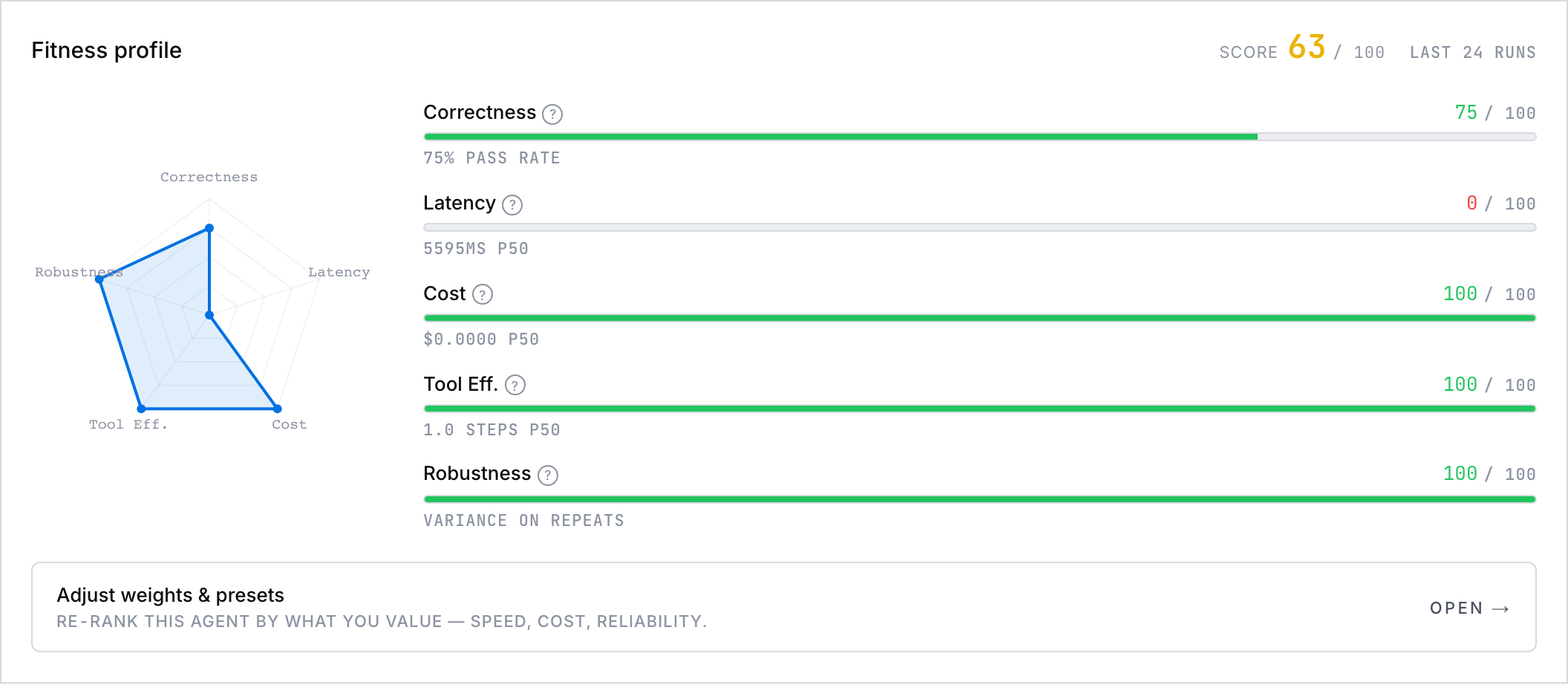
Fitness profile, production, as an anonymous visitor sees it. The collapsed spoke is latency.
The latency floor is real, and you cannot prompt your way out
Three axes at 100, correctness at 75, and latency at zero. The zero is not a misconfiguration — it is the honest verdict on a four-node graph running a 3B model on a laptop. Each node makes at least one model call and the tool loops add more, so a single task costs five or six sequential inferences at a median of 820 ms each. That is ~5.6 s end to end, and Badge's latency axis scores it at the floor.
Latency is also part of why the headline 63 sits below the 75 profile score, and the gap is worth understanding rather than dismissing. The canonical score is 40 × success_rate + 30 × reliability + 30 × cost_score. Cost is a free 30 here, and the 75% success rate contributes 30 of its 40. But reliability is outcome consistency multiplied by a latency factor, and both terms work against this agent: an 18/6 split of passes to failures scores 0.25 on consistency, and a 5511 ms average scales that by a further 0.45. The reliability term therefore pays out 3.4 points of a possible 30. Latency is charged twice — once on its own axis, and again as a multiplier inside reliability.
Any locally-hosted agent should expect latency to be its worst axis. The levers that actually move it are structural: fewer sequential model calls, a smaller model, parallel subagents instead of a chain, or hosting the model somewhere with an accelerator. Prompt engineering does not move it at all.
The architecture graph
This is what the telemetry buys you — Badge never saw the source code:
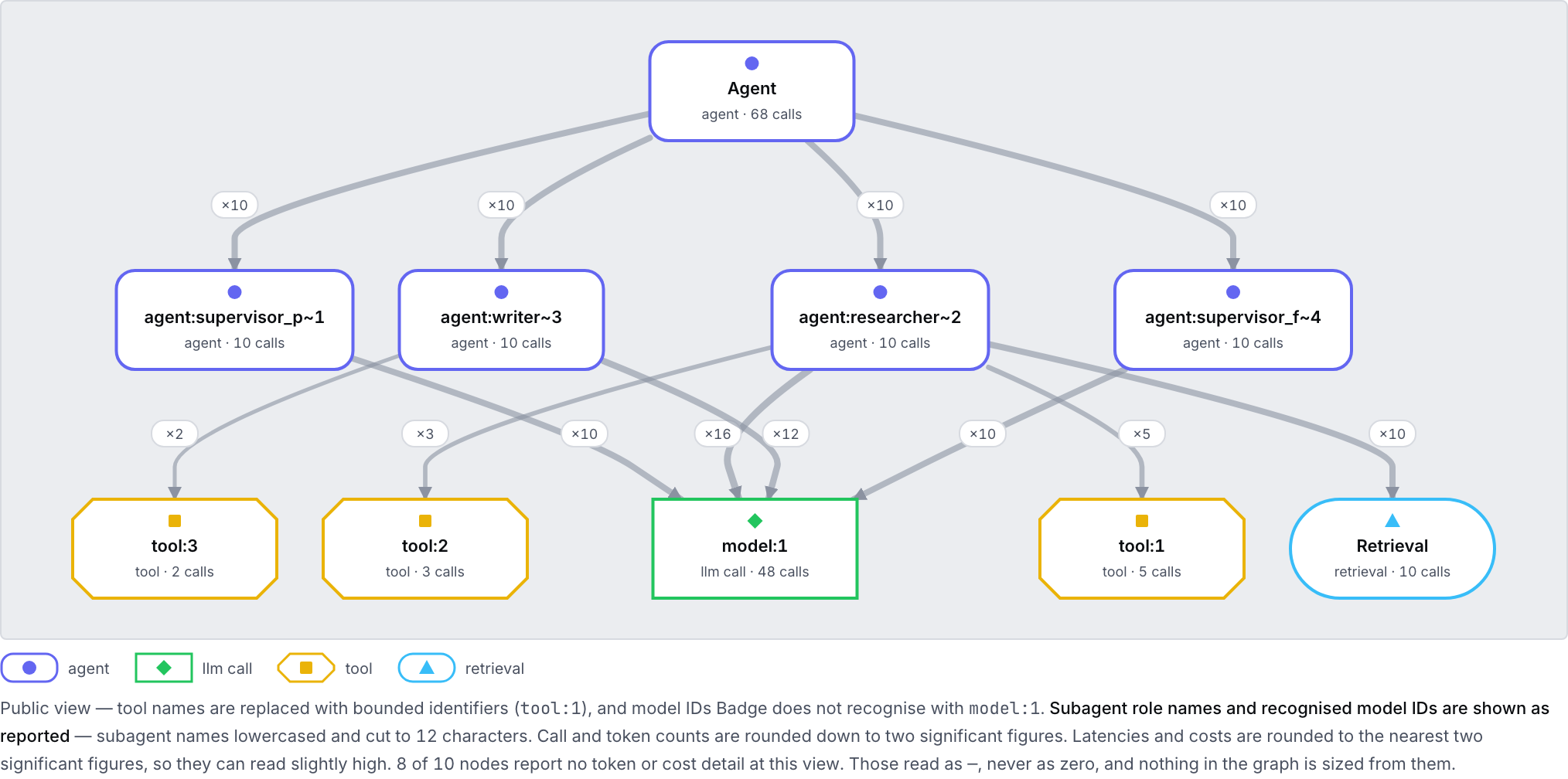
Agent Blueprint, production, aggregated from the latest 10 traced runs (118 spans), as an anonymous visitor sees it.
The reconstructed structure, from the same response. These are the public labels — an owner reading the same Blueprint back sees stored digests (agent:supervisor_plan~a460b0c4, model:925b2caf983238a5) in place of the ordinals:
Agent (root, 68 calls)
├── agent:supervisor_p~1  ×10 → model:1     ×10
├── agent:researcher~2    ×10 → model:1     ×16
│                             → Retrieval   ×10
│                             → tool:1      ×5
│                             → tool:2      ×3
├── agent:writer~3        ×10 → model:1     ×12
│                             → tool:3      ×2
└── agent:supervisor_f~4  ×10 → model:1     ×10
That is the graph from agent_app.py, recovered from spans alone. Note the label evidence_label: "self-reported telemetry — consistent with claims, not proof" that Badge attaches — it is your telemetry, and Badge says so rather than implying it verified your internals.
Three things in that picture are worth reading slowly:
The tool nodes are sparse, and that is the signal. Three tools appear, but at 5, 3 and 2 calls across 10 runs — not 10 each. A tool is called only on the runs whose task actually needed it; the rest of the time a temperature-0 model correctly declined to call anything. The distribution is lumpier than the totals suggest, too: tool:1 was called once each in five different runs, while all three tool:2 calls landed inside a single run — one task that looped. If your graph shows no tool node at all, that is usually a statement about your tasks, not about your instrumentation.
The edge counts do not match the node counts, and they are not supposed to. researcher is entered 10 times but makes 16 model calls, because a tool result sends it back to the model for a second pass. writer shows the same pattern at 12 calls to 10 entries. That ratio — model calls per subagent entry — is the cheapest available read on how much your graph loops, and it is invisible from source code alone.
One model node, not several. Every llm_call in this graph collapses into a single model:1 at 48 calls, because they are all the same local model. A second node would mean a second distinct model id — worth checking for, because it is how you notice a subagent quietly pointing at something you did not intend.
Finally, a limit rather than a caveat: the Blueprint aggregates the latest 10 traced runs, while the score above used 24. The two panels are answering different questions off different windows. A Blueprint that looks thinner than your run count is not missing data.
Per-step cost and latency
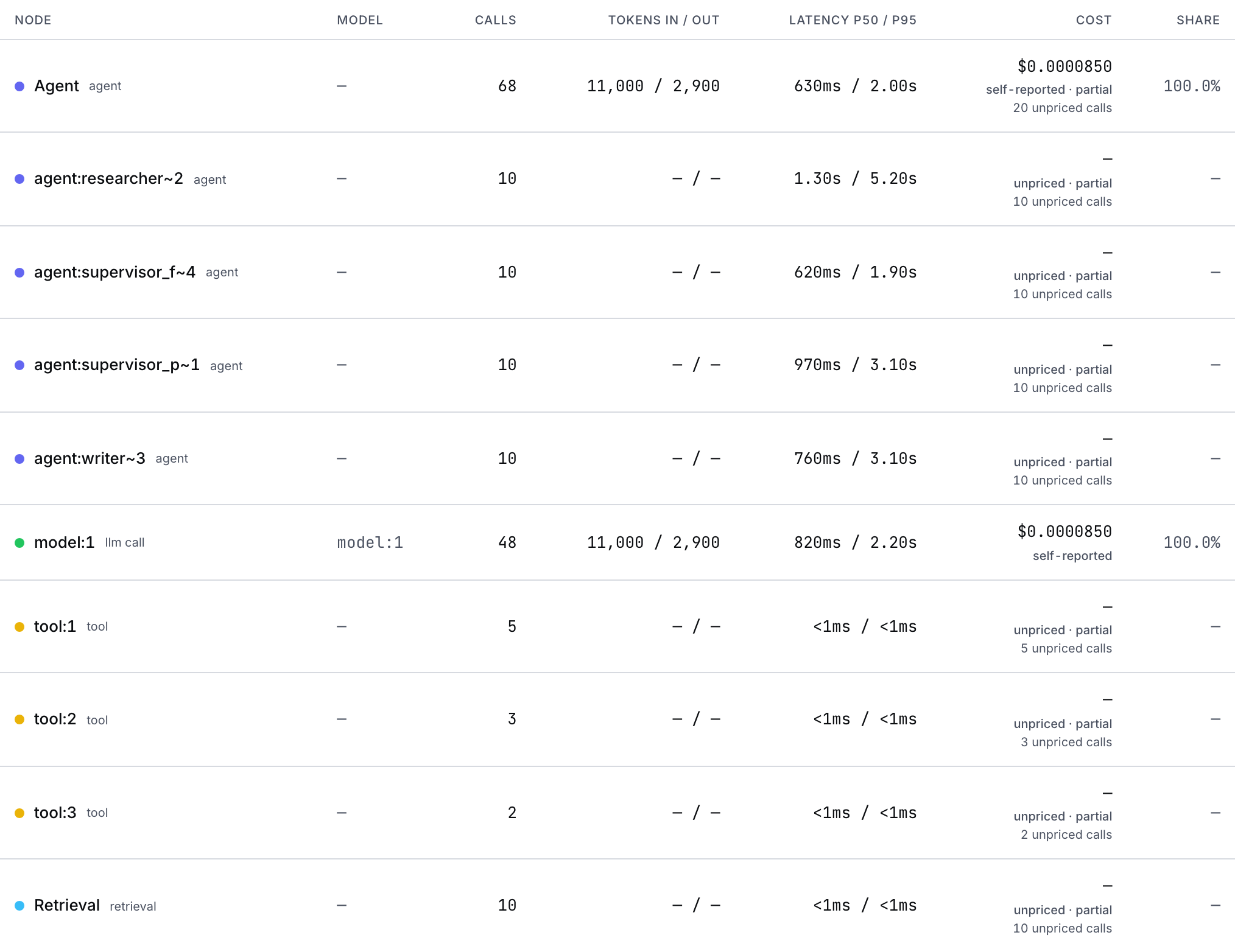
Per-node metrics, production, public view. Cost carries a provenance label on every row.
| Node | Calls | Tokens in/out | Latency p50 / p95 | Cost | Source |
|---|---|---|---|---|---|
| Agent (root) | 68 | 11,000 / 2,900 | 630 ms / 2.00 s | $0.0000850 | self-reported · partial (20 unpriced calls) |
agent:supervisor_p~1 | 10 | — | 970 ms / 3.10 s | — | unpriced |
agent:researcher~2 | 10 | — | 1.30 s / 5.20 s | — | unpriced |
agent:writer~3 | 10 | — | 760 ms / 3.10 s | — | unpriced |
agent:supervisor_f~4 | 10 | — | 620 ms / 1.90 s | — | unpriced |
model:1 | 48 | 11,000 / 2,900 | 820 ms / 2.20 s | $0.0000850 | self-reported |
tool:1 | 5 | — | <1 ms / <1 ms | — | unpriced |
tool:2 | 3 | — | <1 ms / <1 ms | — | unpriced |
tool:3 | 2 | — | <1 ms / <1 ms | — | unpriced |
| Retrieval | 10 | — | <1 ms / <1 ms | — | unpriced |
The per-node latencies are where the tuning signal lives. researcher is the slowest node — 1.30 s p50 against 620–970 ms for the other three, and 5.20 s at p95. Its p95 is the only one that is a multiple of its own p50, which is the fingerprint of a node that sometimes does much more work than usual: it is the node that loops back through the model after a tool call. If you wanted to move the latency axis, that is where to start, and you would not have known it from reading agent_app.py.
The — in the token and cost columns of every subagent row is not missing data. Tokens are reported on the llm_call spans, so they aggregate onto model:1 and onto the root, never onto the subagent that made the call. That is also why the root shows partial with 20 unpriced calls: the retrieval and tool children carry no cost, and the root is honest about how many of its descendants had none rather than quietly treating them as zero.
Per run, rather than per node:
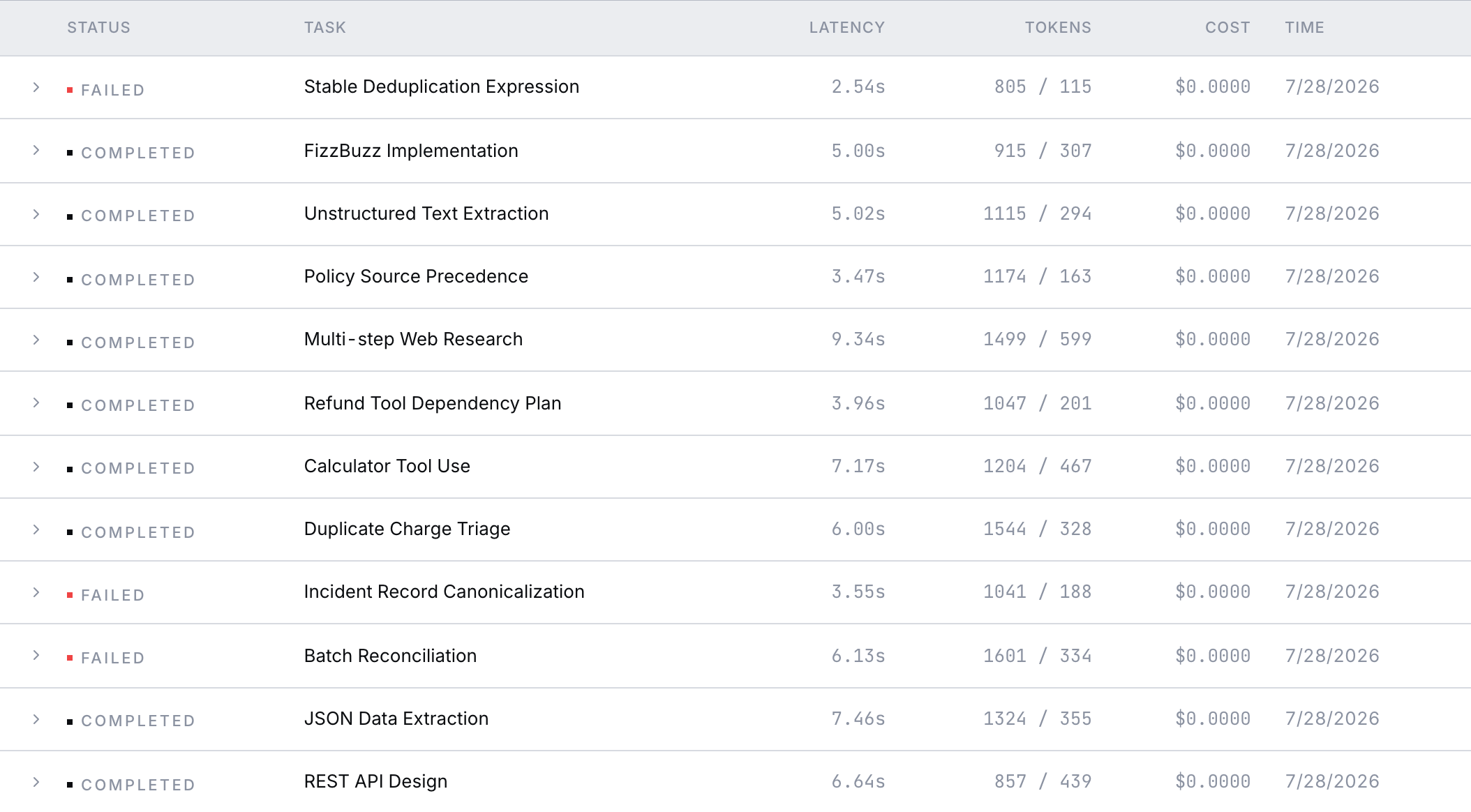
Recent runs, production. Twelve distinct tasks; the screening ran each one twice, so the second repeat of each continues below the crop.
The repeats are where the robustness score comes from. Every one of the twelve tasks returned byte-identical token counts on both runs, while the wall-clock latency moved on every single one:
| Task | Both repeats | Tokens in/out | Latency, run 1 / run 2 |
|---|---|---|---|
| Stable Deduplication Expression | failed | 805 / 115 | 2.54 s / 2.57 s |
| FizzBuzz Implementation | passed | 915 / 307 | 5.00 s / 5.19 s |
| Unstructured Text Extraction | passed | 1115 / 294 | 5.02 s / 5.15 s |
| Policy Source Precedence | passed | 1174 / 163 | 3.47 s / 3.55 s |
| Multi-step Web Research | passed | 1499 / 599 | 9.34 s / 9.42 s |
| Refund Tool Dependency Plan | passed | 1047 / 201 | 3.96 s / 4.04 s |
| Calculator Tool Use | passed | 1204 / 467 | 7.17 s / 7.32 s |
| Duplicate Charge Triage | passed | 1544 / 328 | 6.00 s / 6.02 s |
| Incident Record Canonicalization | failed | 1041 / 188 | 3.55 s / 3.65 s |
| Batch Reconciliation | failed | 1601 / 334 | 6.13 s / 6.20 s |
| JSON Data Extraction | passed | 1324 / 355 | 7.46 s / 6.08 s |
| REST API Design | passed | 857 / 439 | 6.64 s / 6.79 s |
Identical tokens, different clocks. Greedy decoding makes the output deterministic, so the token counts repeat exactly; nothing makes the timing deterministic, and JSON Data Extraction swung 7.46 s to 6.08 s on identical work. This is what a robustness score of 100 looks like before you read the number — and it is also why you should never infer that a latency difference means the agent did something different.
What "unpriced" means
Your model id never appears. As the owner you read it back as model:925b2caf983238a5; the public page shows model:1. Badge prices from a vendored snapshot of published per-token rates, and llama3.2:3b is not in it — and never will be, because there is no per-token price for weights you run yourself. An id Badge cannot price is an id Badge will not publish.
Every locally-hosted model therefore lands in unpriced unless it self-reports. The escape hatch is gen_ai.usage.cost, which Badge treats as authoritative even when it cannot identify the model. This example reports an energy-derived cost rather than a fabricated one:
def cost(self, seconds: float) -> float:
    kwh = (seconds / 3600.0) * (self.watts / 1000.0)
    return kwh * self.usd_per_kwh
Duration × power draw × tariff. Defaults describe the machine used here (≈40 W above idle while generating, 0.15 USD/kWh); both are overridable. The resulting figures are genuinely tiny — $0.000085 across the 10 traced runs above, around $0.0000090 per run at the median — and that is the correct answer, not a rounding error. It is also why the cost axis scores 100: Badge's cost curve pays full marks below $0.001 per run, and this agent is two orders of magnitude under that.
Mind the
/3600. Watts are a rate per hour. Dropping that conversion overstates every call by 3600×. It cost this example one wrong number before a unit check caught it.The alternative is worse: omit
total_cost_usdentirely and Badge estimates from token counts at GPT-4o reference pricing, which overstates a local model by roughly a thousandfold.
Where the missing 25% went — and why a 100% would have been worse news
Eighteen of 24 runs passed. The six failures are three tasks that failed both of their repeats. Which three matters far more than how many:
| Task group | Tasks | Result |
|---|---|---|
| Public, no answer key | 4 | all passed |
| Public, with a published answer key | 2 | all passed |
| Secret holdout, key withheld | 6 | 3 passed, 3 failed |
Every failure is on a held-out task, and every publicly-visible task passed. That gap is the whole reason holdout suites exist, and a 100% pass rate would have told you strictly less than this 75% does.
Four of those passes are weaker than they look. Badge's grading contract is that a task with no answer key grades on completion only — any non-empty output passes. Four of the twelve tasks here have no key at all, so their passes mean "it ran", not "it was right". Remember the offline run earlier that confidently answered 576 EUR when the answer was 1440 — it would have passed one of these.
The three failures are the opposite case, and they are informative precisely because the key is withheld. Each produced plenty of output — 115, 188 and 334 output tokens — and still graded output_mismatch, an outcome only reachable when a task does have an answer key and the answer did not match it. A 3B model got three held-out reasoning tasks wrong, twice each, identically.
Which leads to the one reading of this scorecard you should take away:
Robustness 100 and correctness 75 are both correct, and together they say something neither says alone: this agent is reliably wrong on three tasks.
Robustness rewards determinism, not accuracy. A task that fails both of its repeats has a per-task pass rate of exactly 0.0, which is perfectly consistent, which scores as maximally robust. Read the robustness axis as a quality signal and you will misread it exactly here — it is a measure of whether you can reproduce the result, which is what makes the three failures worth debugging rather than retrying.
Robustness, and what it actually measures
Badge scores robustness on whether repeated runs of the same task agree. A scripted agent scores a trivial 1.0; a real model has to earn it.
Measured on this graph, one prompt, six runs each, on the machine described above:
| Temperature profile | Distinct outputs | Modal agreement | Wall p50 |
|---|---|---|---|
greedy (all nodes at 0.0) | 1 of 6 | 100% | 4.83 s |
sampled (0.2 / 0.3 / 0.5 / 0.5) | 3 of 6 | 67% | 6.48 s |
Reproduce it — note that the profile is read by the server when it compiles the graph, so it must be set on the server process, not on the measurement script:
# terminal 1
BADGE_EXAMPLE_BACKEND=ollama BADGE_TEMPERATURE_PROFILE=sampled PORT=8787 \
  ./.venv/bin/python server.py

# terminal 2
./.venv/bin/python measure_variance.py --runs 6
Your numbers will differ, and that is the finding. An earlier measurement of the identical setup produced 6 distinct outputs of 6 at 17% agreement, where the run above produced 3 of 6 at 67%. Sampling variance is itself variable. Do not treat the table as a specification — treat the direction as the lesson, and measure your own.
The direction is robust, and it is not obvious. An intermediate profile that makes only the final call greedy barely helps — it measured 5 of 6 — because that call still receives a different draft from upstream every time. Variance propagates downstream. Robustness is a property of the whole graph, not of the node that writes the answer. If your distinct-output count is above 1 and you want to change one thing, change the temperature of the earliest node that varies.
Troubleshooting
Every failure below was actually hit while building or verifying this guide.
ConnectError: [Errno 61] Connection refused from measure_variance.py. That script is an HTTP client, not a graph runner — it POSTs to a server at http://127.0.0.1:8787/execute. Start server.py first.
The temperature profile has no effect. BADGE_TEMPERATURE_PROFILE is read when the graph is compiled, which happens in the server process at startup. Setting it on the measure_variance.py command line does nothing. Set it on the server and restart.
Spans are rejected with 422 OTLP trace does not match the registered run dispatch. Your agent started its own trace instead of adopting the inbound traceparent. An agent-scope token may only report on trace ids Badge registered at dispatch. Extract the W3C context from the request headers and parent your spans into it.
422 badge.run_id attribute is required for agent-level OTLP tokens. Every span batch sent with an agent-scope token must carry badge.run_id. Take it from the X-Badge-Run-Id request header and stamp it on every span.
Spans accepted (200) but no graph appears. Most often the run was not dispatched live. Badge derives Blueprints only for runs it genuinely dispatched — a simulated setup check produces no graph by design. Confirm the run landed execution_mode: live_endpoint.
Subagent nodes are missing but LLM nodes are present. Your node names cannot be shaped into [A-Za-z][A-Za-z0-9_-]{0,15}. Dots, leading digits, URL-like or credential-like shapes, and names over 64 characters are dropped silently. Rename the nodes.
Everything renders but tool names are opaque. Expected, and it depends on who is looking. Reading your own agent back as its owner, tool names are always stored as tool:<sha256[:16]> — there is no readable-tool allowlist — and that digest is deterministic, so you can compare shapes across runs even though the label is unreadable. An anonymous reader does not get the digest at all: they see a per-response ordinal (tool:1, tool:2), numbered by first appearance in the graph they were served. Those ordinals are positional, not stable identities — the same tool can be tool:2 in one response and tool:1 in another, so do not treat them as keys to join on across responses.
Every cost reads unpriced and the model is a hash. Expected for any locally-hosted model: Badge prices from a snapshot of published per-token rates, and weights you run yourself have no such rate. Report gen_ai.usage.cost on your spans and total_cost_usd on your response — Badge treats both as authoritative even for a model it cannot identify. See what "unpriced" means.
409 An agent named '...' is already registered. Agent names are globally unique across all Badge accounts, not per account. Pick a different name.
Test Connection times out but curl works. The wizard allows 10 s; screening allows 60 s. Warm the model first. See the tunnel guide.
The tunnel URL stopped working. Quick-tunnel URLs change on every restart, and the old hostname stops resolving immediately — Badge keeps dispatching to a dead URL and the failures score as a failing agent. Re-register the new URL, or use a named tunnel for anything beyond a first experiment.
A spec-compliant OTLP/JSON exporter used to be rejected. Badge's JSON path originally accepted only proto3-canonical JSON with base64 ids, rejecting the hex ids the OTLP spec mandates. Both are accepted now. The http/protobuf exporter used by this example was never affected.
Where to go next
- Interpret and improve your scores — what each axis rewards and which ones you can actually move.
- Screening an agent that runs on your machine — the tunnel, and what exposing it costs you.
- Build a multi-agent app Badge can screen — the deterministic, LLM-free version of this graph.
- The complete source — every file this page uses, in full, on this page.